


This article was created by a student taking part in the English Wizards internship programme. The author’s perspective is preserved; English Wizards provides editorial review, fact-risk corrections and presentation.
Teaching English to young learners in Poland can be a rewarding experience. In the classes I observed, families and schools placed real value on children building confidence in English. However, it does not come without its challenges, especially in Poland. Therefore, understanding the nuances of teaching Polish learners can make a significant difference in your effectiveness and enjoyment as an educator. In this blog post, we’ll explore various tips, strategies, and activities to help you engage and educate young learners in Poland.
Polish Context
English is a common part of the Polish school curriculum and many extracurricular programmes. For a student teacher, the useful question is less about status and more about how children experience the language in practice. For that reason, Polish parents often prioritize English learning from an early age, which means there is a strong focus on developing language skills in schools and extracurricular programs and honing all of the skills the kids might already have.
So, what are the challenges of teaching English in Poland?
Of course, there are challenges associated with teaching young children in every country all around the world, such as a poor attention span, losing interest frequently, still developing communication skills, and limited vocabulary in their own native language. However, we must also focus on the challenges strongly associated specifically with Polish children. And what would those be?
Limited Exposure to English
While it’s not uncommon for children to be exposed to English outside the classroom – via social media, movies, books, or even sometimes family members – some children have limited exposure. Unlike countries where English is widely spoken, frequently used on social media, or even more popular, some children mainly encounter English during their scheduled classes. That fact alone makes it harder for them to practice, revise, and better memorize what they learn.
Grammar
Some classrooms place a heavy emphasis on grammar and written skills. While these are important, not only it can lead to a lack of focus on speaking and listening skills, but also the children often begin to associate the grammar with something heavy and unenjoyable. Polish and English organise tense and aspect differently, so patterns that feel natural in one language may need explicit practice in the other.
Pronunciation and Intonation
Polish speakers (including children) face big challenges when learning English pronunciation, since those two languages are very different in that matter. Polish has a very small set of vowel sounds compared to English, and it does not differentiate between long and short vowels – not to mention that the English language has several vowel sounds that do not exist in Polish. The same is true for some consonant sounds! Last but not least, in Polish, spelling usually matches the pronunciation. Therefore, Polish kids will likely read the English word exactly as it is written.
Large Class Sizes
Class size varies by school, but larger groups can make individual attention harder. Such a large number requires a big classroom to fit them all, which makes it quite challenging to give individual attention to each student and to spot their
doubts, hesitations, or needs. During the lesson, they can often be drowned out or intimidated by fellow peers. Due to that, managing a large group of young learners requires effective classroom management strategies and creative teaching methods – and, of course, a lot of patience.
Diverse Learning Needs
As in the rest of the world, in Poland, children come from different backgrounds and have varying levels of exposure to English. Some may have had private tutoring before, attended English preschools, or have a close family member who lives abroad. Others can be complete beginners who have never used or heard English before. Catering to this diversity requires careful planning and differentiation, as well as clever strategies.
Cultural Sensitivity
Polish culture is rich with history and traditions. Understanding cultural differences and incorporating them into your lessons can help build rapport with students and their families. For example, incorporating Polish holidays, famous figures, or historical events into your lessons can make learning more relatable and engaging.
So, what can we do to address these challenges?
Appropriate Materials
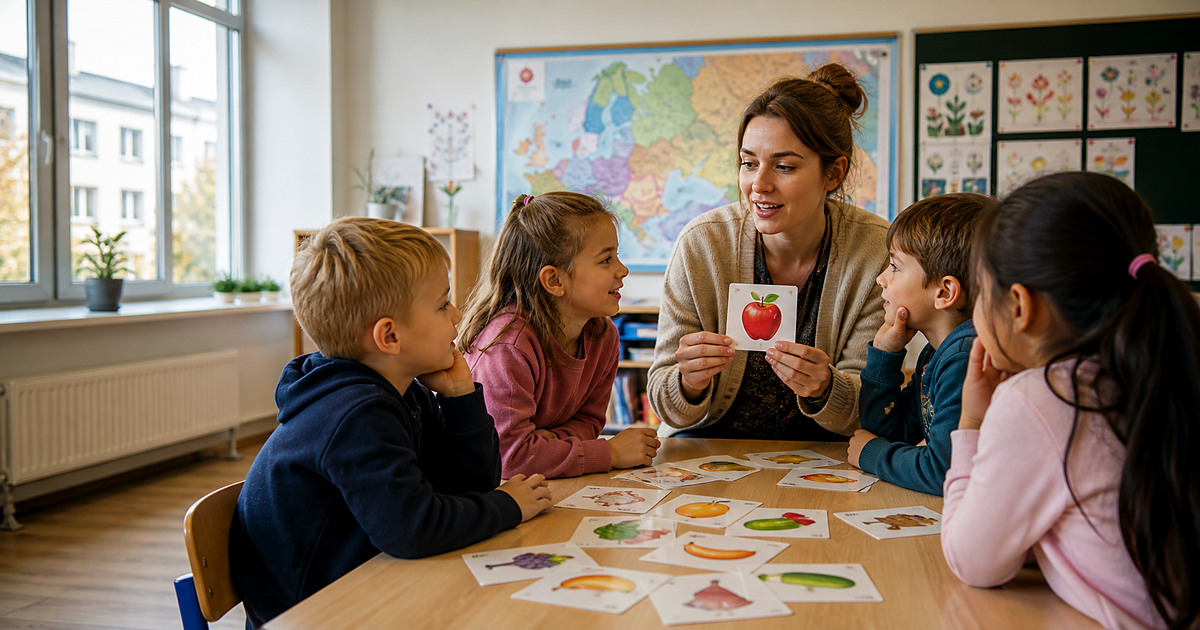
When teaching young learners, it’s important to choose materials that are suitable for their age – materials that are not too challenging for very young learners but will not be found boring by slightly older groups. Useful materials for younger groups include vivid gestures, rhymes, and sometimes even songs – this way, the kids will associate English, even the frustrating grammar, with something light and fun. For slightly older groups (or even the youngest ones), flashcards can be a useful option – they help to catch their focus when it comes to learning new vocabulary and will build recognition in the minds of the children, for example, “Green . . . Oh, yes, the word police officer was on the green flashcard!”
Play-Based Learning
Play is a powerful tool for learning, especially for young children. It helps them explore new topics in a natural and enjoyable way that they will later associate with fun. Role play can be particularly effective because it gives language an immediate purpose. They involve creating scenarios where students can practice everyday conversations – for example, ordering food, shopping, or talking about movies. This approach relaxes them more than talking to an adult and helps bring fun to the dialogue. Making a real-life dialogue will prolong their attention on the conversation at hand and allow you to overhear their pronunciation and catch any possible areas for improvement. However, if your group turns out to be slightly too young for making a dialogue, interactive storytelling also seems to be a great idea! Children always pay more attention when you do something that catches their interest, such as using puppets, props, moving around, making gestures, and changing your voice. They also like repeating key words or phrases in such situations and will remember them for later.
Learning Environment
Creating a supportive and welcoming classroom atmosphere is crucial for young learners, especially since they can sometimes get scared or insecure – especially by slightly intimidating peers who perhaps know English better, or have been learning it longer. That’s why it’s so important to praise students for their efforts, no matter how small they might seem. Children will most likely always feel pressure to keep pace with others – however, they will not, since everybody learns at different paces, and everybody has different needs, as we mentioned earlier. Therefore, remember to always try to be patient and offer help, and make sure your young students know it’s perfectly okay to raise a hand, ask a question, or ask for help – or even ask for a little bit more time to finish a task. That way, it ensures the kids feel better and that nobody is left behind!
Technology and Multimedia
Technological development is enormous and surrounds us quite literally everywhere, and we absolutely cannot ignore that. Instead, we can incorporate it to make the lessons more dynamic and engaging, and in the meantime, show the children a healthy way of using media. Considering the use of videos and cartoons (age-appropriate, of course) might be a good idea. They show young students proper pronunciation and intonation and help them with a very practical aspect of English: listening to what the other person is saying in a conversation.
Group Activities
Collaboration not only helps children develop social skills and learn from each
other but also makes them more relaxed while still learning. During group activities, they focus on each other, not the teacher, and thus feel slightly more confident. Great ways to incorporate this might be pair work or group projects – for example, creating a poster on a specific subject, practicing dialogues and conversations, or solving puzzles, tasks, or completing worksheets together. They will give their entire attention to such a task, remember it later as engaging and fun, and will be able to count on the help of their peers, which will ensure everybody is on a similar level and their language needs are catered.
Polish Language and Culture
Integrating learning English with the students’ native language and culture is absolutely crucial. We don’t want to separate those two things entirely, especially since children will give their full focus to what they already know, or at least have heard of. It’s important to provide translations or explanations in Polish to help with comprehension and give them a mental image of how English stands next to Polish. Cultural comparisons also always work amazingly – saying things like “In England, this is a holiday you don’t have, just like you have a holiday English people don’t have – for example…”. This will give them a very nice association for later. When it comes to vocabulary, it’s best to start with topics that are already familiar to students in their native language – basic vocabulary about their friends, family, and generally the world surrounding them. Then you can gradually introduce new English vocabulary, subjects, and concepts.
Routines and Structure
Children generally thrive on routine, as it provides them with a sense of security and predictability, and makes them feel safer and more stable. Therefore, it’s great to have a consistent lesson structure and set-in-stone classroom rules. This way, children know what to expect, how to behave, what’s expected of them. They learn and memorize this very quickly and work more efficiently if they don’t have to stop in confusion or surprise every few minutes. Also, remember to use informal assessments regularly, such as quizzes or games, to check the understanding and progress of your students without making it too formal or serious. After all, learning English isn’t supposed to be scary or stressful – it’s fun!
Lastly, The Feedback
It can be a bit tricky, since young learners – both children and teenagers – are wont to take any areas for improvement for harsh criticism, but nonetheless, feedback plays a crucial role in the learning process and cannot be forgotten. Constructive feedback make students understand their strengths and helps them see areas for improvement. For younger children, positive feedback can boost confidence and motivation, encouraging them to explore new concepts. Teenagers, however, benefit from more specific and actionable feedback that helps them refine their skills and deepen their understanding. Always remember to be patient, focus on the positives and be sensitive, so the students can feel taught as well as valued. Teaching English to young learners in Poland presents a unique set of challenges, but with the right strategies and ideas, it can also be an incredibly fulfilling – and very fun – experience. By understanding the specific challenges Polish children face, you can come up with multiple approaches to help them and meet all of their needs. The goal is to create a learning environment where children feel encouraged and excited to explore the English language. With patience, creativity, and cultural sensitivity, teachers can inspire a true love of learning – after all, English is a beautiful language, and not that difficult! So, dive in, have fun, and good luck!
