

This article was created by a student taking part in the English Wizards internship programme. The author’s perspective is preserved; English Wizards provides editorial review, fact-risk corrections and presentation.
Introduction
If you want to understand Poland in the summer, don’t start with museums. Start with a field, a stage, a market square. Start where the sound checks bleed into sunset and strangers clink plastic cups of cold beer as if they’ve known each other for years. Poland in winter is disciplined and inward. Poland in summer exhales. Cities spill into parks, riverbanks fill with bicycles and food trucks, and the festival calendar becomes a second heartbeat. It isn’t just about music or fireworks. It’s about a particular Polish mix of melancholy and mischief — the ability to dance to electronic bass at midnight and argue about poetry at breakfast. Among dozens of summer events, three stand above the rest: one that turns a seaside town into a rock capital, one that sets Kraków humming with global rhythms, and one that stages a medieval-meets-modern spectacle on the Baltic coast. Each reveals a different face of the country. Together, they form a map of contemporary Poland.
The Freedom Pulse: Pol’and’Rock Festival
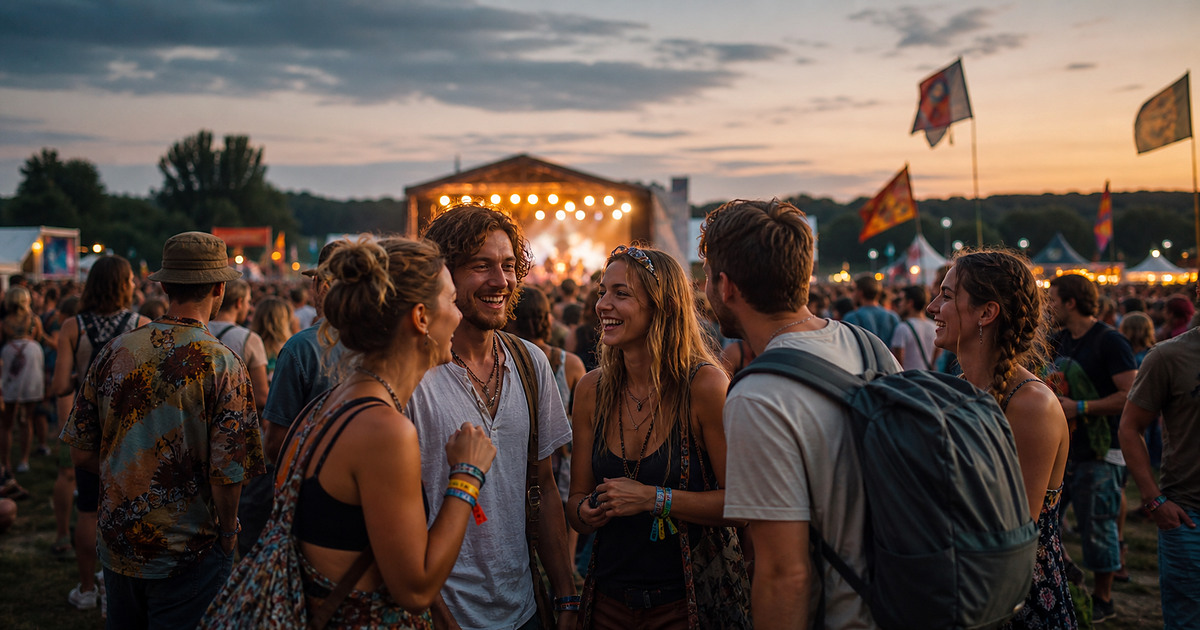
The first thing you notice at Pol’and’Rock Festival is scale. A sea of people stretches to the horizon, sunburned shoulders and homemade flags bobbing above the crowd. It looks chaotic from above, but on the ground it feels oddly orderly — like a temporary republic built on guitars and goodwill. Formerly known as Przystanek Woodstock, the festival was created in the 1990s as a thank-you to volunteers who raised money for the Wielka Orkiestra Świątecznej Pomocy (Great Orchestra of Christmas Charity). That origin story matters. The event is free, fiercely independent, and anchored in a civic ethos. The music ranges from classic rock to metal, punk, and increasingly international acts. But the real drama unfolds between songs. When a huge festival crowd moves together on cue, the energy can feel physical. You feel it in your ribs. The campsite is its own city. People share grills and stories. A group of students from Poznań once invited me into their tent circle for żurek (sour rye soup) cooked on a portable stove. We spoke about politics, about leaving and returning to Poland, about why this gathering feels necessary. “For three days,” one of them said, “you don’t have to defend your optimism.” Pol’and’Rock captures a side of Poland that outsiders often miss: loud, self-ironic, allergic to pomp. It’s messy, yes. But it is also disciplined in a grassroots way. Volunteers direct traffic. Security works without swagger. The result is something closer to a social experiment than a festival — a reminder that freedom here is not abstract. It’s practiced. From this raw field energy, it makes sense to move south — to a city where history presses in from every façade and summer music weaves through medieval streets.
The Urban Soundtrack: Męskie Granie in Kraków
If Pol’and’Rock is a republic of tents, Męskie Granie in Kraków feels curated, urban, intentional. Its name translates loosely as “Men’s Playing,” but don’t be misled. What began as a platform for male artists has evolved into a broader celebration of contemporary Polish music, collaboration, and reinvention. Each summer, the festival tours major cities, yet Kraków’s edition carries particular weight. Perhaps it’s the backdrop — the Wisła (Vistula) river catching evening light, the hum of tourists on Grodzka Street fading as the bassline rises. Or perhaps it’s Kraków’s long habit of intellectual and artistic debate. Here, the audience listens closely. The signature feature is the Męskie Granie Orchestra, a rotating supergroup that rearranges well-known songs into something sharper. What distinguishes Męskie Granie is its confidence. Polish artists don’t mimic Anglo-American trends; they bend them. Indie rock brushes against folk motifs. Electronic producers sample 1980s hits your parents played on cassette. Between sets, people debate lyrics as if discussing literature. In Poland, words matter. A clever line can outshine a light show. The festival also reflects a generational shift. The audience includes thirty-somethings who grew up after 1989, comfortable in the European Union, fluent in irony. They arrive in linen shirts and sneakers, balancing craft beer with nostalgia. And yet, the energy is no less intense. When the headliner hits the stage and the opening chords ripple across the field, the city’s restraint dissolves. Kraków, so composed in daylight, dances without apology. From this urban rhythm, the journey north to the Baltic coast feels natural. If Kraków is a conversation, the seaside is a spectacle.
Fire and Memory: St. Dominic’s Fair in Gdańsk
Every July and August, Gdańsk hosts St. Dominic’s Fair, one of Europe’s oldest trade and cultural fairs, dating back to the 13th century. Unlike the stage-driven festivals of rock and pop, this one spreads through the city itself. You don’t enter through gates; you stumble into it. Stalls line the cobbled streets of the Main Town. Amber glows in glass cases. Artisans hammer silver rings on portable anvils. The smell of grilled oscypek (smoked sheep cheese) drifts past Gothic brick façades. A street magician gathers a ring of children and skeptical adults. “Watch closely,” he says in Polish, then switches to English without missing a beat. Gdańsk has always faced outward. The fair began as a commercial privilege granted by the Pope to Dominican monks. Today it mixes trade with theater, concerts, and historical reenactments. One afternoon, I watched a troupe stage a mock medieval trial, complete with exaggerated accents and audience participation. When the “accused” protested his innocence, a woman next to me shouted, “To Gdańsk with him!” — half joke, half local pride.
Gdańsk carries layers of identity: Hanseatic port, Free City, birthplace of Solidarity. During the fair, those layers feel animated rather than archived. The city’s maritime toughness blends with carnival color. Elderly couples browse antiques beside teenagers buying handmade bracelets. Languages overlap — Polish, German, Swedish, English — echoing centuries of trade. What sets St. Dominic’s Fair apart is its continuity. It is not a modern invention but a ritual that survived partitions, wars, regime changes. Walking through it, you sense how Poland negotiates memory: not by freezing it, but by weaving it into daily life. After the raw democracy of Pol’and’Rock and the curated artistry of Męskie Granie, Gdańsk offers something older: a reminder that celebration in Poland often carries an undercurrent of endurance.
Conclusion
Summer festivals in Poland are not interchangeable entertainment. Each carries a distinct temperament shaped by geography and history. In a vast open field, Pol’and’Rock rehearses civic freedom. In Kraków, Męskie Granie refines a modern cultural voice. In Gdańsk, St. Dominic’s Fair turns centuries of trade and turbulence into a living street theater. Together, they trace a line from rebellion to reflection to remembrance. For international visitors, these events provide more than spectacle. They offer entry into conversations Poles are having with themselves — about community, creativity, and continuity. Stand in a crowd singing in a language you might not fully understand, and you will still feel the rhythm. Share soup at a campsite or haggle over amber in a medieval square, and you will grasp something textbooks cannot convey. Poland in summer does not hide its contradictions. It amplifies them — with guitars, with orchestras, with church bells and street vendors. If you want to see the country alert and unguarded, come when the days are long and the stages are loud. The rest of the year explains Poland. Summer lets you experience it.
