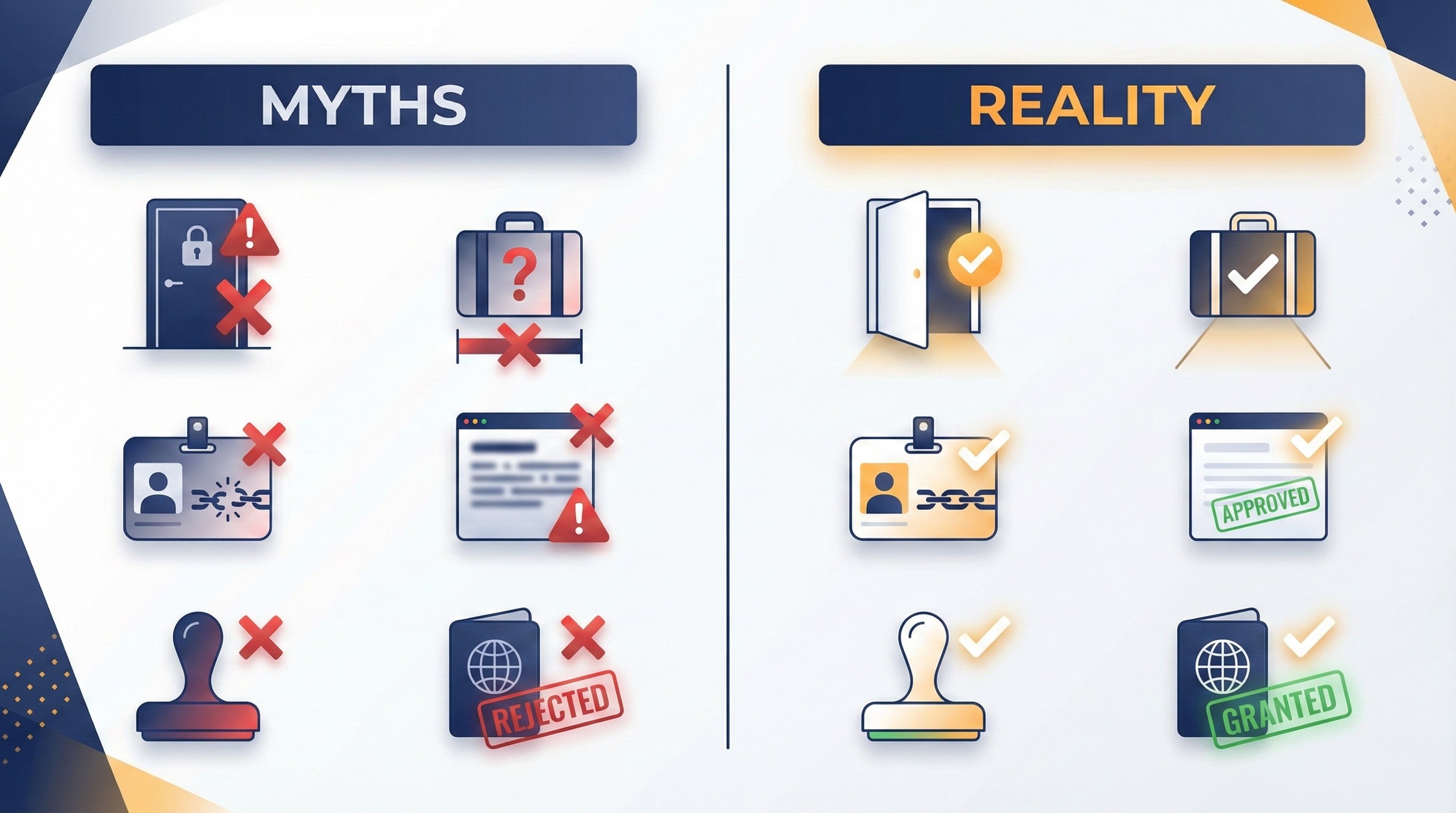
Residence permit myths in Poland: 12 myths debunked (2025 update)
Residence Permit Myths in Poland are still pushing thousands of foreigners into unnecessary stress, panicked decisions, and even accidental overstays. You see it every day in Facebook groups, Telegram chats, and bar conversations: “You can’t leave once you apply.” “You’re not allowed to work until the card arrives.” “If your visa expires, you’re illegal the next morning.” Most of this is either half-true, outdated, or flat-out wrong.
This updated 2025 guide pulls everything into one place and goes far beyond the old “8 myths” version. We’ve expanded it to 12 of the most common misconceptions about Polish residence permits, added post-2022 legal changes, and integrated new issues like the EU Entry/Exit System (EES) and work rules for students and job-changers. Instead of vague “it depends” answers, you’ll see clear scenarios: when you can travel, when you can work, what happens if you lose your job, and how your family or partner can stay with you in Poland.
The goal isn’t to turn you into a lawyer. It’s to give you enough clarity to stop relying on random comments, avoid the worst mistakes, and know when it’s worth paying for professional help. If you’re already waiting on a Temporary Residence Card (TRC), thinking about applying, or trying to understand what happens after your current visa or card expires, this article is your starting point. Read it once, keep it bookmarked, and use it as a reality check whenever someone confidently tells you “how Poland works.”
Below, you’ll find the 12 biggest myths, each with plain-language explanations, real-world examples, and practical next steps you can act on immediately.
📢 Important Update – 2025 Immigration Reforms in Poland
A new article is now available detailing the latest 2025 immigration changes in Poland. While many reforms are still being finalized or implemented at the local (voivodeship) level, it’s crucial to stay informed about the national legal direction. This guide offers a full breakdown of what’s changing, what it means for foreigners, and how to prepare.
Myth 1: You Can’t Leave Poland While Your Residence Permit Is in Progress
One of the most persistent Residence Permit Myths in Poland is the idea that the moment you file your application and get the famous red stamp, you are “stuck” in the country until your plastic card arrives. That sounds logical, but it is not how the law actually works.
The key point is this: your temporary residence application and the red stamp do not give you permission to cross the border, and they also do not block you from crossing the border. They are neutral. To leave and come back, you still need a separate legal basis to enter Poland or the Schengen Area, such as a valid national visa, a still-valid residence card, or a passport that allows visa-free entry.
If you are using visa-free entry to stay in Poland, you also have to respect the standard 90/180-day Schengen rule. Once you have used up 90 days of visa-free time inside Schengen, you cannot simply “pause” that clock by filing a residence application. If your 90 days are already used, a new trip out and back into Schengen will not be possible until enough time passes to restore days on your 180-day window.
There is one more nuance that causes a lot of confusion. Some nationalities benefit from bilateral agreements with Poland which sit next to the Schengen rules and can, in specific situations, allow extra time in Poland that does not count toward the 90/180 clock. In practice, this means that certain citizens (for example from the USA and a short list of Latin American and Asian countries) may be able to leave and re-enter Poland more flexibly while their residence permit is pending, as long as they travel directly in and out of Poland and rely on Polish border control, not another Schengen country’s interpretation.
For everyone else, the safe strategy is simple:
Apply for your temporary residence permit as early as the law allows, while your visa or visa-free days still have plenty of time left.
Use that remaining time for any essential trips outside Poland, always checking your current Schengen day count before you travel.
Once your visa or 90/180 allowance is fully used, plan to stay put in Poland until your new residence card is issued.
All too often, foreigners wait until the very last week before a visa expires to submit their application, assuming that they will be “banned” from travel as soon as they file. In reality, the opposite approach is smarter. Filing earlier usually gives you more room to move, more options to travel legally, and a calmer wait for your card instead of feeling trapped.
Bottom line: submitting your residence application does not magically lock you inside Poland. Your real limits come from your visa status, your Schengen 90/180 balance, and (for a minority of passports) any bilateral agreement your country has with Poland, not from the red stamp itself.
Myth 2: You Can’t Work While Waiting for Your Residence Permit
This is one of the most stressful Residence Permit Myths in Poland because people assume that once their visa expires and they enter the “stamp phase,” they must stop working completely until their new card arrives. That would leave most foreigners without income for months, but the law doesn’t say that—and it never has.
The truth is simpler: whether you can work while waiting depends entirely on what work rights you already had on the day you applied. The stamp itself doesn’t give you permission to work, but it also doesn’t take away rights you already possessed.
If you applied while holding a valid work permit, a valid declaration, a work-authorized national visa, or a residence card with “dostęp do rynku pracy,” you can keep working for the same employer under the same conditions while your new permit is processing. This continuation rule is written directly into the Act on Foreigners and is confirmed by every voivodeship’s published guidance.
Full-time university students and recent graduates have an even clearer situation. Polish law lets them work without a work permit at all, regardless of whether they’re still waiting for their residence card. As long as they remain enrolled full-time, they can work freely for any employer, any hours.
On the other hand, if you applied without any pre-existing right to work—such as entering visa-free and applying for a TRC without a work permit—then you cannot legally work until your employer obtains a permit for you. The stamp alone does not grant new work authorization.
A lot of confusion comes from HR departments, recruitment agencies, and even some accountants who don’t understand these distinctions. You may have to point employers to the official FAQ for your voivodeship. But the core principle is consistent nationwide: your ability to work during the waiting period is based on the rights you already held, not on the stamp.
Myth 3: You Must Submit a 100% Perfect Application or You’ll Be Rejected
This is one of the most damaging residence permit myths in Poland because it makes people delay their applications until the very last moment. The belief is that if even one document is missing—an updated lease, a new bank statement, or a fresh employment contract—the voivodeship will reject your case immediately. That isn’t how the Polish administrative process has traditionally worked, but recent digital changes mean the reality now depends heavily on where you apply.
In the classic paper-based procedure, timing matters far more than perfection. When you submit your application on time, the office checks only the formal basics: the form, photos, fee, signatures, and whether you applied before your legal stay ended. If those elements are correct, your case is accepted and you enter the queue. Months later, when an inspector finally reviews your file, they will typically send a “wezwanie do uzupełnienia” and give you 7–14 days to provide any missing contracts, bank statements, or insurance documents.
Polish administrative law requires the voivodeship to give you a chance to correct mistakes or supply missing evidence. That is why, in hybrid or paper-based voivodeships, incomplete applications are still formally accepted first and then cleaned up later through one or more wezwania. For people applying in those regions, the smart strategy is usually to file as early as possible, even if one attachment is missing, because a timely but imperfect application keeps you legal and gives you space to fix gaps later.
However, the introduction of the new MOS system changes how this myth works in practice in places like Warsaw and other fully digital voivodeships. The online portal will not let you move forward without uploading the mandatory attachments listed for your purpose of stay. If a document is missing, you simply cannot submit the application at all. In those regions, the old advice of “apply first and supplement later” is no longer possible—the system itself enforces a higher level of completeness on day one.
This is why the myth is no longer fully debunked or fully true. In MOS voivodeships, you really do need your core documents ready before you can apply, because the portal won’t accept an incomplete file. In other voivodeships still operating on hybrid or paper processes, you can usually submit with minor gaps and rely on wezwania to fill them in later. The right approach is to check which system your voivodeship uses and plan your document strategy around that, not around generic advice from Facebook groups.
If you are applying in an MOS voivodeship and don’t want to gamble on missing something important, this is exactly the point where structured help pays off. Our fixed-fee TRC support for $195 is designed to make sure your application meets the current checklist for your voivodeship and that you actually get through the MOS submission screen on the first try, instead of finding out too late that one “small” document is blocking the entire process.
Myth 4: Your Legal Stay Ends the Day Your Visa or Residence Card Expires
This myth creates more panic than almost any other, because people assume the date printed on their visa or residence card is a hard deadline to leave Poland. The moment that date arrives, many foreign residents believe they automatically become “illegal.” In practice, Polish and Schengen rules give most foreigners more legal breathing room than they realize.
If you submitted a new residence permit application before your current document expired, your stay in Poland continues to be legal until the final decision is issued. This legal extension comes directly from the Act on Foreigners and applies even if the waiting time stretches far beyond the original expiry date. The extension applies only to Poland, not the wider Schengen Area, but inside Poland you remain fully legal throughout the decision process.
If you did not apply for a new permit before your visa or card expired, you may still not be out of options. For citizens of visa-free countries, the day after your long-term visa or residence card expires, your 90-day Schengen visa-free allowance begins. Time spent in Poland under a visa or residence permit does not count against the 90/180 Schengen limit, which means most visa-free nationals automatically receive up to 90 days of legal stay after expiry without exiting or re-entering the Schengen Area. There is no need for a “border run” to activate this period; the clock simply starts on its own.
This rule does not apply to nationals who require a visa to enter Schengen. For them, missing the extension deadline truly does mean their stay ends on the expiry date unless they leave Poland or have another valid basis. But for visa-free nationals, the idea that you must leave the very day your card or visa expires is simply wrong. You can remain legally—either through a pending TRC application or through the visa-free regime.
With the rollout of the EU Entry/Exit System (EES), these post-expiry periods are now tracked automatically. EES does not change the underlying rules, but it removes ambiguity by logging the day your long-term stay ends and counting your short-term days from that point forward. What it does mean is that overstays will now be detected with perfect accuracy, so understanding how your post-expiry rights work is more important than ever.
The bottom line is straightforward: the printed expiry date rarely represents your actual last legal day in Poland. Your true deadline depends on whether you applied on time, whether you are visa-free, and how many short-term Schengen days you still have available. Once you know these pieces, the fear around expiry dates largely disappears.
Myth 5: You Must Always Carry Proof of Your Pending Application or Risk Trouble
Many foreigners believe that once their visa or previous residence card expires, they must carry their stamped passport page or MOS submission confirmation everywhere they go. The idea is that if police or border guards stop them and they can’t show proof on the spot, they could be fined, detained, or treated as overstaying. This fear comes from how other countries handle immigration checks, not from how Poland operates.
Inside Poland, you are not legally required to carry proof of your ongoing TRC application. Police, border guards, and municipal authorities can check your status directly in the national foreigners’ database, where every pending case is recorded. As long as your application was submitted on time and formally accepted, your stay is legal regardless of whether you can show a stamp or paper confirmation during a random encounter.
Random ID checks are also extremely rare. In practice, most status checks happen only if you are involved in an incident, formal procedure, workplace inspection, or border control. Even then, presenting a passport is usually enough for the officer to look you up in the system. The red stamp or MOS confirmation is a convenience tool, not a legal requirement.
The confusion comes from mixing up local checks with Schengen travel rules. While Polish authorities can see your case status, officers in other Schengen countries cannot. This is why people get into trouble when they attempt to transit through Germany, the Netherlands, or France with an expired visa and only the Polish stamp to show at the airport. Outside Poland, authorities cannot access your pending case file, so they treat you based on the document in front of them—which is why you should avoid Schengen travel entirely while waiting, unless you still hold a valid visa or visa-free days.
Within Poland, you can leave the stamp or confirmation safely at home if you prefer. Carrying it may save a few minutes of explanation, but not carrying it does not put your legal stay at risk. The real rule is simple: your status is verified in the system, not in your pocket.
Myth 6: Losing Your Job on a Work-Based Residence Permit Means You Must Leave Poland Immediately
Many foreigners still believe that if they lose their job while holding a temporary residence and work permit, their legal stay ends instantly and they must leave Poland within days. This used to be closer to the truth many years ago, but the law has changed significantly. Today, job loss does not automatically cancel your residence permit, and you are not forced to leave Poland unless a formal decision is issued by the voivode.
Your residence card remains valid until its expiry date or until the voivodeship formally revokes it. Employers cannot “cancel” your residence card, and job loss does not invalidate it by default. What has changed in recent years is the introduction of a structured, legally recognised process that allows you to switch employers without starting your entire TRC all over again.
If your employment ends, you must notify the voivode within 15 working days. This is the step that protects your ability to use the simplified job-change procedure. As long as you notify on time, you may file a request to amend your existing permit to reflect a new employer. This avoids the long timelines of a full TRC application, costs less, and keeps your status stable while the amendment is processed.
In most voivodeships, once the amendment application is filed and your previous permit is still valid, you can remain in Poland legally throughout the transition. Some employers prefer to wait for the amendment to be approved before you start working, but many allow the new employment to begin after filing, depending on local practice and their internal risk tolerance.
If you do not find a new job immediately, your residence card still remains valid. You can legally stay in Poland until your card expires or the voivode chooses to review your case. In practice, voivodeships rarely initiate revocation solely because someone is between jobs, especially when the person is actively seeking new employment or preparing to change the basis of their stay.
The real danger is not job loss itself—it’s failing to notify on time or misunderstanding how the amendment process works. When handled correctly, losing a job does not force you to leave Poland, start over, or jeopardise your long-term plans.
Myth 7: Your Spouse and Children Can’t Join You Until You Have Your Own Residence Permit
Many families assume that the main applicant must first receive their temporary residence card before their spouse or children can apply to come to Poland. This leads to long, unnecessary separations and the belief that dependents are “blocked” until the principal foreigner’s TRC is approved. In reality, Polish immigration law does not require this sequence at all.
If you have a valid basis for your stay—such as a work contract, university admission, business activity, or another legal ground—your immediate family members can apply in parallel. They can request national visas abroad based on family reunification, enter Poland legally, and submit their own residence permit applications even while yours is still pending. The law recognizes that families should not be separated simply because the principal applicant is waiting in the queue.
The voivodeship may wait to issue a final decision on the family’s TRC until your own decision is granted, but that does not prevent them from accepting the applications early. Your spouse and children do not need to remain outside Poland for months; they can be here legally, enrolled in school, or settling into life while the paperwork moves forward.
The only real limitation is work authorization. Most spouses of non-EU foreigners do not automatically gain the right to work in Poland until their own residence card is issued. They may live in Poland legally but still require a separate work permit if they wish to start employment. This is separate from their right to join you, which is not restricted by the timing of your TRC.
Families sometimes run into problems because they assume they must follow a rigid order of approvals. In reality, the system is far more flexible. As long as the main applicant’s basis of stay is legitimate and financially viable, dependents can enter Poland and begin their own processes without waiting for your residence card to arrive.
Myth 8: Only Married Couples Can Use Relationship-Based Residence Permits
A lot of foreigners assume that Poland recognizes only formal, legally registered marriages when it comes to relationship-based residence permits. This leads many unmarried couples to believe they have no path to live together in Poland unless they get married first. While marriage does make the process cleaner, Polish law does not restrict all family-based applications to married couples only.
Poland recognizes the concept of a factual relationship (“związek faktyczny”) for immigration purposes. This doesn’t mean every dating couple qualifies, and it doesn’t grant the same privileges as marriage, but it does allow long-term, committed partners to apply for temporary residence based on the relationship—provided they can demonstrate that it is real, stable, and long-standing. This evidence can include shared leases, bills, travel history, correspondence, and other proof of building a life together.
The key point is that the voivode must be convinced the relationship is genuine and that the couple intends to live together in Poland. Unlike marriage-based cases, where the legal status itself carries weight, factual-relationship cases rely more heavily on documentation and a consistent story. Some voivodeships review these cases more thoroughly, especially if partners come from countries with stricter immigration profiles. But the legal pathway exists nationwide, even if the practical scrutiny varies.
One important limitation is that partners applying through a factual relationship do not automatically receive work authorization the way spouses of EU citizens might. Their right to work depends entirely on the basis of their partner’s stay. If the main applicant has a work-based TRC, the partner usually needs a separate work permit unless their own card later grants access to the labor market.
For couples who share a real, documented life but are not married, the idea that they have “no legal route” is simply incorrect. The process may involve more evidence and patience, but the law provides a path for unmarried partners to obtain residence in Poland on the basis of their relationship.
Myth 9: A Polish Residence Card Lets You Live and Work Anywhere in the EU
This myth spreads quickly because it sounds logical: Poland is an EU country, a Polish residence card is an EU-format document, and the card itself says “Residence Permit.” Many foreigners assume this gives them the right to move freely to another EU country, live there long-term, or accept employment without additional paperwork. Unfortunately, that is not how EU mobility rules work.
A temporary residence card issued by Poland grants you the right to live and work in Poland only. It does not grant the right to work in Germany, the Netherlands, France, Spain, or any other EU state. In those countries, you are treated as a non-EU national and must follow their immigration rules if you wish to take up employment or settle there. The card allows you to travel within Schengen for up to 90 days in any 180-day period, but travel is not the same as residency.
A lot of confusion comes from mixing up different EU statuses. The long-term EU residence permit—sometimes called the “EU Blue Card equivalent” even though it is not—does allow easier movement between member states, but even that status is still based on strict national conditions and requires a minimum of five years of legal stay in Poland. A standard temporary residence permit does not offer these mobility rights.
Another misconception is that a Polish employer can send you to work in another EU country long-term simply because you hold a Polish TRC. While short-term business travel may be possible, performing regular work abroad generally requires the appropriate local authorization in the destination country. Your Polish card does not override their labor or immigration laws.
For most non-EU nationals, the Polish residence card is exactly what it says: permission to stay in Poland. It is not an EU-wide residency or work permit, and relying on it as if it were can lead to border problems, employer sanctions, or being denied entry to another member state. Understanding this protects you from some of the most common relocation mistakes made by newcomers to Europe.
Myth 10: Moving to Another Voivodeship Cancels Your Residence Permit
Many foreigners believe that once they move from one voivodeship to another—especially from smaller regions into cities like Warsaw or Kraków—their residence permit becomes invalid or “belongs” to their previous address. This misconception is understandable because each voivodeship has its own office, procedures, and processing style. But legally, your residence permit is tied to Poland as a country, not to a specific region.
Changing voivodeships does not cancel your residence card, and it does not create a new obligation to reapply from scratch. Your existing card remains valid nationwide until its expiry date. What does change is your responsibility to update your address with the correct authorities. For most foreigners, this means updating your PESEL entry or submitting an address notification through the appropriate local office. The residence permit itself remains untouched.
The confusion usually comes from situations where the basis of stay changes along with the move. For example, someone moving to a new city to start a new job must amend the decision if their permit is tied to their employer. Others may switch from work to study, from study to business activity, or from one family situation to another. These changes can trigger updates or amendments—but the move itself is not the cause. It’s the underlying change in your basis of stay that requires action.
It’s also common for people to worry about inspections or “control visits” at their old address. While voivodeships sometimes perform address checks, these do not invalidate your permit simply because you’ve moved. If an inspector visits your previous address and you no longer live there, the office may ask for clarification, but the solution is to provide your updated address rather than restart the entire process.
In short, your residence permit follows you anywhere in Poland. Moving cities does not wipe your status, cancel your card, or reset your immigration history. What matters is keeping your address information current and ensuring your basis of stay remains legally valid after the move.
Myth 11: Permanent Residence Is Automatic After a Few Temporary Cards
Many foreigners assume that once they have held two or three temporary residence cards, permanent residence is simply the next step. This idea usually comes from how residency works in other countries, where long-term stay automatically transitions into permanent status. In Poland, the rules are far more specific, and holding multiple TRCs on its own does not create eligibility.
Permanent residence in Poland is tied to strict legal categories. For most non-EU nationals, eligibility is based on five years of continuous legal stay, combined with a stable basis of residence and proof of integration. Time spent on certain permits does not always count in full—student permits, for example, count at half value, and short gaps caused by late applications or rejected appeals can reset the clock entirely. Simply accumulating cards is not the metric; maintaining a continuous, qualifying stay is.
Another common misunderstanding is that any five-year period works. In reality, the five years must be legally continuous, documented, and based on a purpose of stay that counts toward permanent residency. People who switch frequently between study, work, business, and family grounds may find that parts of their timeline do not qualify, even if they have lived in Poland for many years without interruption.
Even when the time requirement is met, permanent residence is not guaranteed. Applicants must still show stable income, legal housing, health insurance, and—depending on the category—basic Polish language skills or proof of integration. Many refusals happen not because someone lacked time in Poland, but because the supporting evidence did not meet the formal standards set by the voivode.
The belief that permanent residence “just happens” after a few cards leads many people to overlook gaps in their timeline, periods that don’t count, or documentation they should have been collecting all along. The process is entirely achievable, but it is not automatic—and the earlier you understand what actually counts, the easier it is to plan your long-term residency strategy.
Myth 12: New Laws Mean Students Can’t Work Without a Permit Anymore
Every few months, a wave of panic hits international student groups claiming that “students can no longer work without a permit.” These posts usually appear after headlines about labor inspections, MOS digitization, or amendments to the Act on Foreigners. The result is confusion, fear, and students turning down perfectly legal jobs because they think the rules have changed. In reality, the core regulation has stayed the same for years: full-time students at recognized Polish universities may work without a work permit.
The misunderstanding comes from how different groups interpret inspections and administrative changes. Labor inspectors increasingly check whether students are actually enrolled full-time and whether the work performed matches their legal basis of stay. This has nothing to do with removing the student exemption. It simply means employers must document student status correctly, and students must maintain active, full-time enrollment. When either of these conditions fails, the exemption no longer applies.
Another source of confusion is how student status interacts with changing residence permits. If a student holds a student-based TRC but decides to switch to a work-based TRC, their right to work without a permit comes from being a full-time student—not from the work-application process. If they stop studying full-time, their automatic work rights end. The law has not changed, but students often misunderstand why they were allowed to work in the first place.
Finally, MOS has not introduced any new work restrictions for students. The digital system simply requires the university’s confirmation and documentation to be uploaded correctly. The exemption itself remains unchanged. Students who are properly enrolled full-time may continue working without a permit, and employers may hire them legally without going through the standard work-authorization procedures.
The myth persists because students hear about inspections, TRC delays, or MOS requirements and assume the work exemption has been removed. It hasn’t. The rule is still clear: if you are a full-time student at a recognized Polish university, you may work without a work permit. The moment your status changes, your work rights do too—nothing new, nothing revoked, just the same long-standing rule applied consistently.
Want the safest and most cost-effective TRC support in Poland?
For $195, we review all your documents, verify your local voivodeship requirements, and complete the TRC application form on your behalf.
Real Scenarios: How These Myths Play Out in Real Life
Understanding the rules is one thing. Seeing how they apply in real situations is where most foreigners finally realize how many problems these myths cause—and how easy they are to avoid once the facts become clear. The examples below are based on patterns we’ve seen across years of cases, combined with the most common situations newcomers face.
Scenario 1: “I applied before my visa expired, but now I need to travel.”
A software developer from South Africa submitted his TRC application a month before his visa expired. When a family emergency came up, he assumed he couldn’t leave Poland anymore. In reality, he still had unused Schengen visa-free days, meaning he could exit and re-enter Poland legally. The myth cost him two stressful weeks before he finally learned he wasn’t trapped.
Scenario 2: “My employer says I must stop working until my new card arrives.”
A teacher on a valid work permit changed schools mid-year. HR at the new school insisted she couldn’t work because she didn’t have the physical card yet. Her previous permit, however, remained valid, and she applied for an amendment on time—meaning she could continue working legally. The myth existed only in HR’s manual, not in the law.
Scenario 3: “We’re not married, so my partner can’t stay with me.”
A couple living together for years assumed Poland would reject any residence application because they weren’t married. Once they provided a documented history of living as a household, the voivode accepted the factual-relationship basis without issue. Their mistake was relying on expat hearsay rather than the actual legal definition of “family member.”
Scenario 4: “I lost my job—do I have to leave now?”
A logistics worker lost his job after his company restructured. He believed he had to leave Poland immediately because his card was tied to his employer. He filed the job-loss notification within 15 working days, submitted the amendment request, and remained fully legal. The myth nearly pushed him into an unnecessary exit trip.
Scenario 5: “I’ve lived here five years, so I automatically qualify for PR.”
A long-term resident with multiple TRCs applied for permanent residency, believing the time alone was enough. Because part of his stay was on a student permit and he had a short administrative gap between cards, he actually fell short of the qualifying five-year continuous period. The denial wasn’t a surprise to the office—it was a surprise only to him.
These examples show the same pattern again and again: myths grow when rules sound complicated, and people act on them because they seem logical. Once you understand the real framework, the fear disappears and the path forward becomes far more predictable.
Comparison Table: What the Myth Says vs. What Actually Happens
This table distills the most common residence-permit myths in Poland into a quick, factual reference. Each row shows the outdated belief, the legal reality in 2025, and what foreigners should actually do in that scenario. It’s designed as a rapid-scan tool for readers who prefer clarity without the long explanations.
Myth
Reality in 2025
What You Should Do
You can’t leave Poland during TRC processing.
You can exit, but you can’t re-enter unless you have visa-free days or a valid visa. EES removed old bilateral exemptions.
Check remaining Schengen days. If none, don’t leave without a new visa.
You can’t work while waiting.
You can if you had work rights beforehand (permit, declaration, full-time student status). The stamp doesn’t remove or add rights.
Verify your basis (student, existing permit, etc.) and show HR the legal references if needed.
You must have every document ready on day one.
Depends on the voivodeship. MOS-only regions require full uploads; hybrid/paper regions still accept partial files and request supplements.
Check your region’s system. If MOS: prepare full pack. If hybrid: file early and supplement later.
Your stay ends the second your visa or card expires.
Not true for visa-free nationals. A 90-day tourist clock starts automatically after expiry.
Confirm if you’re visa-free. Use those days for travel or to file a new permit.
You must always carry proof of your TRC application.
Authorities can verify your case in the system. Not carrying the stamp is not illegal.
Carry ID; keep a digital copy of your confirmation for convenience, not legality.
Losing your job invalidates your permit.
The permit stays valid. You must notify the voivode within 15 working days and can file a job-change amendment.
Report the change, secure a new offer, and apply for a permit amendment.
Your family can’t join until you get your card.
Spouses and kids can apply simultaneously or enter on visas and apply in Poland.
Prepare financial proofs and apply in parallel.
You must be married to sponsor a partner.
Unmarried partners can apply under “other circumstances” with evidence of cohabitation.
Collect proof of a stable relationship and apply on that basis.
A Polish TRC lets you live and work anywhere in the EU.
False. It only allows Schengen travel up to 90 days; no work rights outside Poland.
Apply separately in the destination country if you want to work there.
Moving voivodeships invalidates your permit.
The permit is valid nationwide. You only need to update your address.
Notify the new voivodeship within 15 days; no reapplication required.
Permanent residence is automatic after several TRCs.
PR requires its own application, 5 years of lawful stay, and meeting integration criteria.
Track your continuous-stay timeline and plan for language/income requirements.
New rules removed student work rights.
Full-time students still work without permits. Crackdowns target fake enrollments, not genuine students.
Keep full-time status and documentation updated for inspections.
Want full guidance through your entire TRC process?
Our $350 Ongoing Support Service covers every step from submission to final decision, with priority help whenever the office requests documents.
Frequently Asked Questions About Residence Permit Myths in Poland
These FAQs address the recurring confusion we see in 2025 across Facebook groups, Reddit threads, and direct messages from foreigners navigating Poland’s immigration system. Each answer is based on verified law, official gov.pl guidance, and updated post-EES (Entry/Exit System) rules.
1. Does the stamp in my passport act as a visa?
No. The stamp only confirms you applied for a residence permit on time and legalizes your stay inside Poland until a decision is issued. It does not grant border-crossing rights, and it cannot be used to re-enter Schengen.
2. If my visa expires while waiting, can I still travel in Europe?
Only if you have remaining visa-free days. After your visa or TRC expires, visa-free nationals automatically switch to their 90-day Schengen allowance. If those days are used up, you cannot travel until you obtain a new visa or your TRC is approved. Want to fast track waiting times? Check the 7 proven ways to speed up your TRC decision.
3. Will MOS change how applications are checked?
Yes. In MOS-only voivodeships, mandatory uploads prevent incomplete submissions. Paper or hybrid offices still accept partial files and issue wezwania later. Your experience depends entirely on your voivodeship’s migration stage.
4. Can I switch from student status to work status without leaving Poland?
Yes. Full-time students can transition to a work-based permit from inside Poland as long as they maintain legal stay and provide a valid job offer. Inspections target fake enrollments, not legitimate students.
5. Do I lose my residence permit if I move to another voivodeship?
No. Your TRC is valid nationwide. You only need to update your address within 15 working days. Your case does not reset.
6. Can my employer cancel my residence card?
No. Employers can only terminate employment. You must notify the voivode within 15 working days and can file a job-change amendment to your current permit.
7. Do unmarried partners really get approved under “other circumstances”?
Yes, provided the relationship is genuine and documented. The category is discretionary but well-established. Evidence of cohabitation or shared life significantly strengthens the case.
8. Will applying late ruin my chances?
Applying late makes you illegal immediately if you have no visa-free rights. If you do have visa-free rights, you may still file within those 90 days. But filing late always introduces risk and complexity—apply early wherever possible.
9. Does a Polish TRC let me work in Germany, the Netherlands, or Spain?
No. A temporary Polish residence card only permits Schengen travel (up to 90 days), not employment in other EU countries. Separate national authorization is required.
10. How long does a TRC decision actually take in 2025?
Officially: 60 days. In reality: 4–12+ months depending on voivodeship workload and whether your region has migrated to MOS. Hybrid offices remain slower than digital ones.
Official Sources & Citations
Every claim in this article is backed by authoritative 2025 sources, including Polish government portals, the Act on Foreigners, EU regulations, and high-credibility legal analyses. Below is a consolidated reference list you can rely on for verification or deeper study.
Polish government & authorities (primary legal sources)
These sources reflect the most current legal and procedural landscape as of 2025. Immigration rules shift frequently; always verify with your voivodeship or through an expert consultation before making travel or employment decisions. For full residency support options, go here.
Tax clearance certificate Poland – learn the legal basis, ZAP-3 registration, how to find your tax office, and 4 ways to get a personal no-arrears certificate.
by English Wizards |
December 5, 2025 |
Living in Poland
A complete 2025 playbook for respectful outreach in Poland. Covers law, culture, cooperation, and training.
by English Wizards |
August 19, 2025 |
Faith & Missions
Your privacy choices
We use cookies (not the tasty ones) to keep English Wizards running smoothly and to understand how people move through the site. You choose what extra magic we can use.
Essential
Always active
These cookies are required for the website to work correctly and cannot be disabled.
Preferences
These cookies remember your settings so the site feels consistent every time you visit. They don’t track you — they only store things like language, region, or layout choices.
Analytics
These cookies help us understand how visitors use the site so we can improve it. No personal data is used unless you allow it.The technical storage or access that is used exclusively for anonymous statistical purposes. Without a subpoena, voluntary compliance on the part of your Internet Service Provider, or additional records from a third party, information stored or retrieved for this purpose alone cannot usually be used to identify you.
Personalization
These cookies allow us to use Google Signals and similar tools to personalize content and understand our audience better.