Poland’s 60-Day Residence Permit Plan Is Real. The “Automatic Approval” Headlines Are Not.
Poland’s proposed 60-day residence permit rule could create a powerful fast track for selected temporary-residence applicants. UD408 is not law yet. It will not cover everyone. And it will not guarantee a residence card in 60 days.
Direct answer: The Polish government has published draft legislation known as project UD408 that could allow certain first-instance temporary-residence cases to be treated as approved when the wojewoda does not conclude the case within 60 days. But the proposal is still a draft. No final enacted country list exists, no one has a current right to automatic approval under UD408, and a person could still wait beyond day 60 for security checks and the physical residence card. This proposal must also be separated from Poland’s existing suspension of residence-processing deadlines and the court cases challenging that suspension.
Not confirmed in the official government register checked.
Sejm bill
Not found in the official Sejm bill register checked.
Enacted and published law
No. No UD408 Act was found in the 2026 Journal of Laws register checked.
Final eligible-country regulation
No. The binding country list does not yet exist.
Automatic approval available today
No. UD408 creates no current entitlement.
Next legal trigger: watch for a government-adopted bill, a Sejm print and—if Parliament passes it—publication in the Journal of Laws. Until then, this remains a proposal.
Why the backlog feels like a golden prison
Poland has finally admitted, in unusually plain language, that foreigners can wait many months for residence decisions. Good. Pretending the backlog is normal has never made it normal.
For applicants, “many months” can become something brutal. Their stay in Poland may remain legal while the stamp confirming a pending application does not give them the right to travel through the rest of the Schengen Area. Going home to see a sick parent, attend a funeral or spend Christmas with family can create a re-entry problem unless they still meet the requirements for a visa or visa-free travel. So people stay. Weddings are missed. Grandparents get older through a phone screen. Anxiety, depression and other mental-health problems can become the background noise of ordinary life.
That is the part polite policy language hides. Poland can be safe, beautiful and full of opportunity—and still feel like a golden prison when someone is allowed to live here but cannot confidently leave and come back. They are not held by bars. They are held by an expired visa, a silent file and a bureaucracy that refuses to say when it will finish. English Wizards has already documented a 400-day wait for a Polish residence card. That is what this limbo looks like when legal uncertainty stops being an administrative statistic and starts eating someone’s actual life.
Poland has every right to protect public order, screen applicants and set immigration priorities. Polish taxpayers have every right to expect functioning institutions. Foreigners who follow the rules also have the right to clear procedures, fair treatment and decisions that do not vanish into administrative fog. Those positions are not enemies. A serious immigration system has to hold both at once.
The proposed mechanism concerns selected temporary-residence cases in the first instance before a wojewoda. It does not cover appeals before the Head of the Office for Foreigners.
The officially published draft documentation identifies Australia, Japan, the Republic of Korea, the United States and the United Kingdom as countries that presently appear to satisfy the proposed criteria. That is not a final legal list.
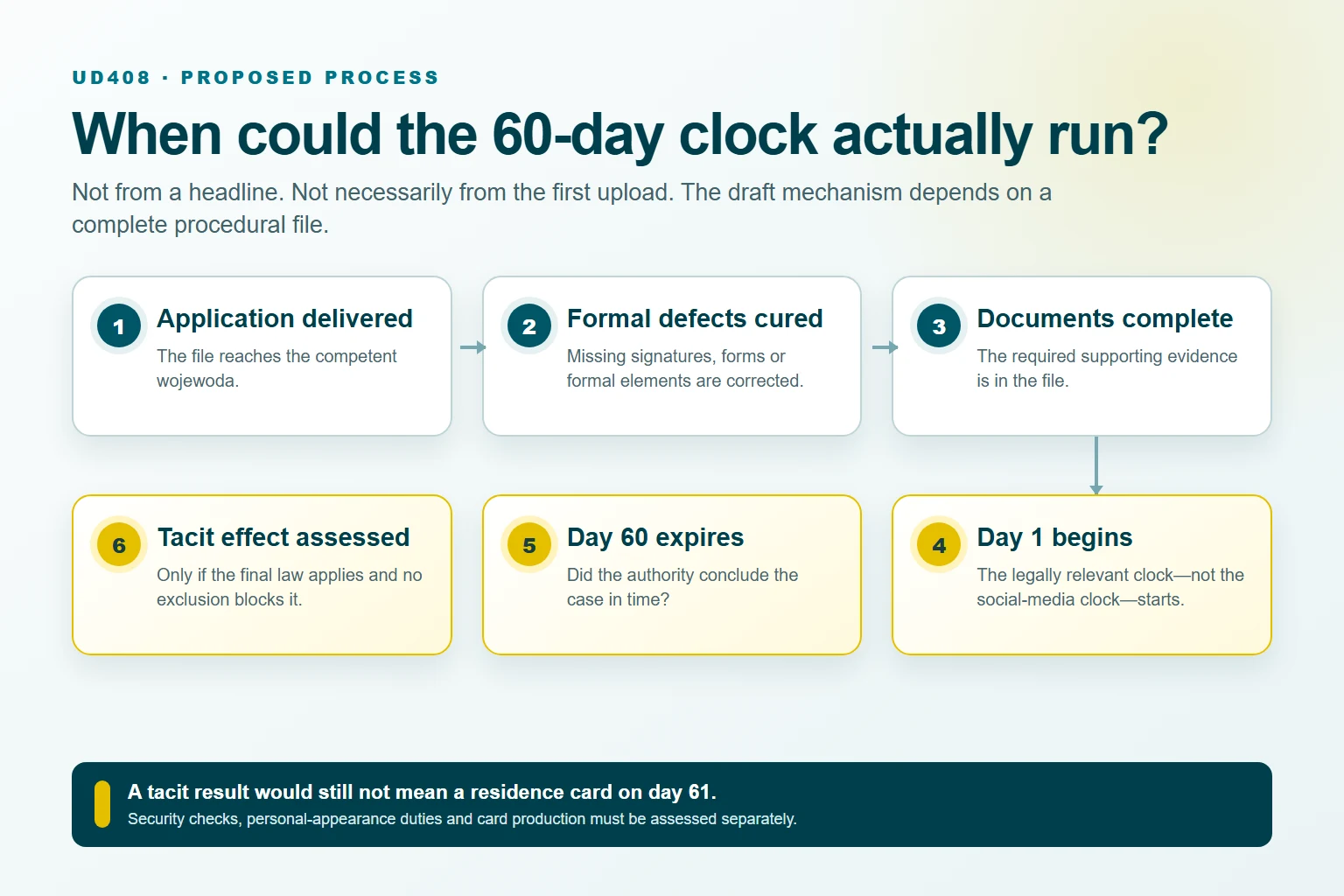
The 60-day clock would not simply begin when someone clicks “submit.” Formal defects, required documents and procedural events matter.
A tacitly granted permit would not necessarily mean a residence card in hand. Security checks could continue, and the office would withhold the card until those checks end positively.
Need a case-specific answer rather than another headline?Check Your TRC Route. Residence requirements depend on nationality, application basis, documents, location and timing. English Wizards’ residence support covers forms, a verified document checklist and a city-specific submission plan.
In this UD408 guide
The UD408 announcement is real. The shortcut is not available yet.
However, the legally sloppy part begins when a draft proposal gets turned into headlines such as:
“Poland now approves residence permits after 60 days.”
“Americans automatically receive a Polish residence permit in two months.”
“The new law applies to all foreigners.”
“A court forced Poland to introduce silent approval.”
“Your residence card will arrive after 60 days.”
None of those statements accurately describes the position on 24 July 2026.
UD408 is not an enacted law. The official government register still labels it as a project. The published materials describe the planned mechanism, but Parliament has not completed the legislative process, the President has not signed a final Act, and no implementing regulation has established a binding list of eligible countries.
So the correct headline is not “Poland has introduced 60-day residence permits.”
The correct headline is:
Poland has published a selective 60-day residence-permit proposal. It could become significant. It is not a current entitlement.
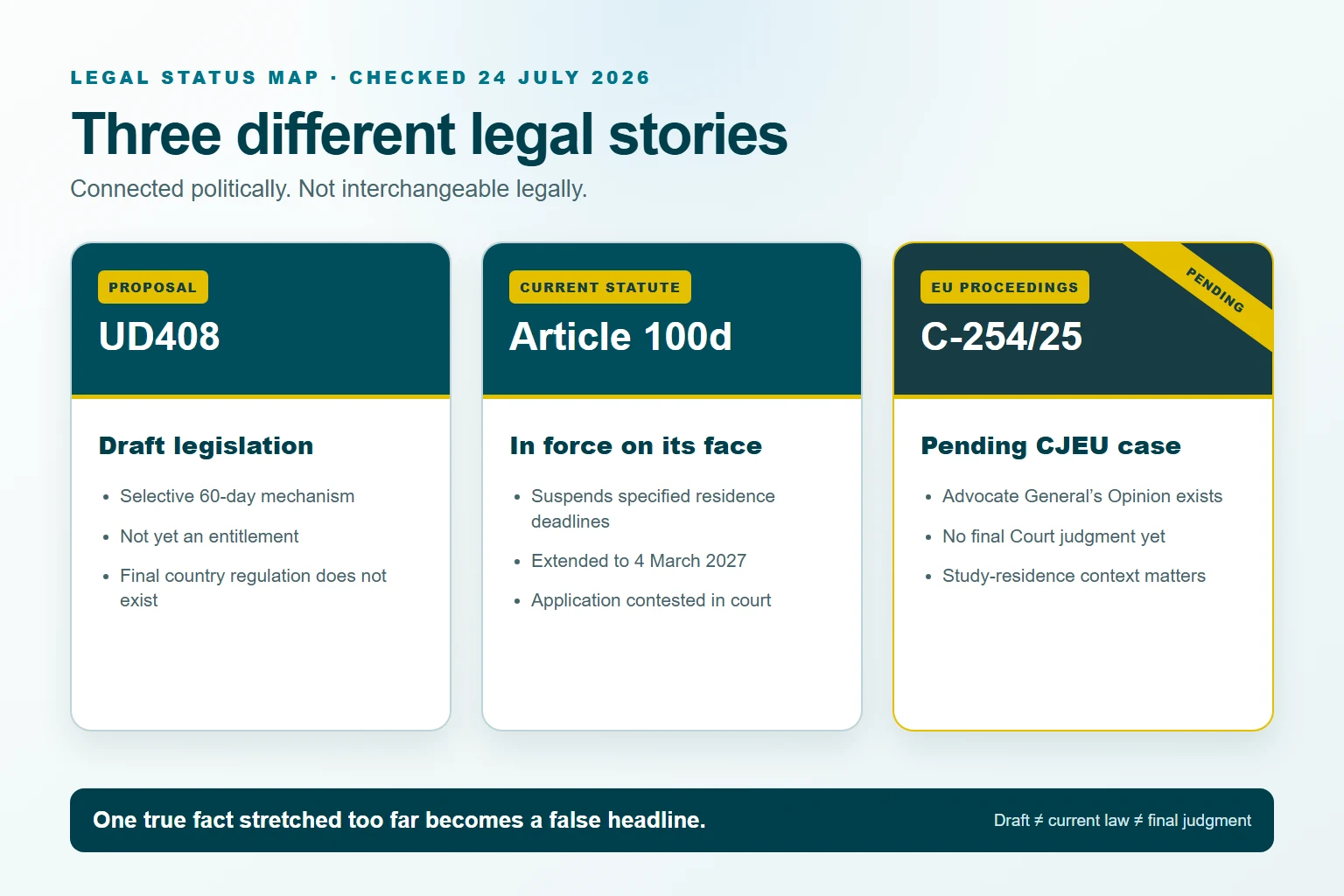
UD408, Article 100d and the court cases are three different stories
Most confusion disappears when the story is split into its three real parts.
Development
What it is
Current effect
UD408
A new government draft proposing tacit conclusion of selected temporary-residence cases after 60 days
Not yet in force
Article 100d
Existing law suspending the running of specified residence-processing deadlines and restricting normal delay remedies
In force until 4 March 2027 on the face of the statute
Polish and EU court proceedings
Cases testing whether prolonged reliance on Article 100d is proportionate and compatible with effective judicial protection
Important, but they have not created the UD408 fast track
These developments interact politically and legally, but they are not interchangeable.
The government’s new proposal is a legislative response to delay. Article 100d is the current statutory regime that helps authorities defend delay. The court cases concern whether that defence can continue to block real remedies. A ruling about Article 100d does not automatically enact UD408. UD408 does not automatically repeal Article 100d. And an Advocate General’s Opinion is not a final judgment of the Court of Justice. This is exactly how a Polish residence-permit myth grows: one true fact is stretched until the legal conditions disappear.
That distinction is the backbone of the entire issue.
What UD408 actually proposes
The government proposes using an existing Polish administrative-law mechanism called milczące zakończenie postępowania—tacit conclusion of proceedings.
Under the proposal, the law could treat an eligible temporary-residence case as resolved fully in accordance with the applicant’s request if the wojewoda does not issue a decision or order concluding the case within the applicable 60-day period. The government intends to insert special provisions into the Foreigners Act so that the general mechanism in the Administrative Procedure Code can operate in this specific category of residence proceedings.
That is stronger than a normal administrative deadline.
By contrast, a normal statutory deadline tells the authority when it should act. Missing it does not automatically give the applicant the permit. The proposed UD408 mechanism would attach a positive legal consequence to silence: where all statutory conditions are met and no exclusion applies, failure to conclude the case in time could itself produce the effect sought by the applicant.
That is why the proposal matters.
It is also why every condition matters.
This is not a blanket rule saying, “No answer in 60 days means everyone wins.” It is a targeted mechanism for selected nationalities, selected temporary-residence categories, first-instance proceedings, complete applications and cases without specified security or public-order problems.
Is “silent approval” accurate for UD408?
Polish media often call the proposal milcząca zgoda, or silent consent. That is understandable, but the Administrative Procedure Code makes a technical distinction.
Article 122a KPA says a matter may be handled tacitly only when a special provision authorises it. It then distinguishes between:
milczące zakończenie postępowania: the authority does not issue a decision or final order; and
milcząca zgoda: the authority does not issue an objection decision.
The UD408 residence proposal is framed around the first mechanism: tacit conclusion of proceedings.
That is not just legal vocabulary for the sake of vocabulary. It explains why nothing happens under current law merely because a residence office has stayed silent for 60 days. The Foreigners Act must first contain the special provision activating the KPA mechanism for these cases. The government itself says this statutory activation is necessary.
UD408 country eligibility: Australia, Japan, South Korea, the United States and the United Kingdom
the Republic of Korea, commonly called South Korea;
the United States of America;
the United Kingdom of Great Britain and Northern Ireland.
That list is important. However, it is provisional.
The draft does not permanently write those five countries into the Foreigners Act. It proposes that the Council of Ministers establish the eligible list by regulation. Legal analysis of the published draft states that the Council of Ministers would publish the list by 30 September each year and that the current justification points to those five countries. Until the principal law and the implementing regulation are enacted, those nationalities have no UD408 entitlement.
Why nationality is only the first question
Even after the law takes effect, holding one of those passports would not be enough on its own. The real assessment would still need to ask:
Is your country on the regulation in force when the relevant rule applies?
Are you applying for a covered type of temporary residence permit?
Is the case in the first instance before a wojewoda rather than on appeal?
Was the application properly filed and free of formal defects?
Were the required documents provided?
Were personal-appearance and identity obligations completed?
Does any SIS, undesirable-person, security, defence or public-order exclusion apply?
Are there procedural events that stop or postpone the clock?
Are you expecting a permit decision, a certificate confirming tacit handling, or the physical residence card? Those are not the same thing.
Are your work, business, study, family, tax, insurance and travel facts aligned with the route you are using?
This is precisely the kind of situation where a generic headline is not enough. A wrong assumption can affect filing strategy, travel, legal stay, business setup and the documents used to prove the purpose of residence.
Citizens of Australia, Japan, South Korea, the United States and the United Kingdom: the responsible first step is Book a Consultation. Bring your nationality, target timing, intended work or business route and the decisions you need to make.
U.S. passport holder planning a work, freelance or business route?Start FastTrack Review. The U.S. route requires coordination between business setup, residence strategy and the applicant’s actual facts; UD408 should not be treated as a substitute for that planning.
How UD408 countries would be selected
The published draft analysis identifies cumulative country-level criteria. A country would need to meet conditions including:
its citizens are eligible for visa-free travel for up to 90 days in a 180-day period;
the country belongs to the Organisation for Economic Co-operation and Development;
gross domestic product per person, measured by purchasing-power parity, exceeds 50,000 international dollars; and
the rate of return decisions involving that country’s citizens remains below the draft threshold—no more than 2% using the stated three-year arithmetic-mean method.
The final regulation could also reflect migration risk, security cooperation and broader state interests.
This architecture has two consequences.
First, the eligible list can change. A country mentioned today is not guaranteed permanent inclusion.
Second, this is openly a selective economic and migration-policy tool. The government says the delay problem affects citizens of highly developed third countries that are strategically important to Poland’s economy and investment goals. The proposal is designed to shorten their real waiting time, not to repair every residence case for every nationality.
That may be politically controversial.
Legally, however, the immediate point is simpler: the final regulation—not a blog post, news headline or explanatory memorandum—would determine which nationalities are covered.
Which residence applications UD408 may cover
The government register says the mechanism would cover most types of temporary-residence permits. It does not say all residence procedures. It expressly limits the mechanism to first-instance cases before wojewodowie and excludes appeal proceedings before the Head of the Office for Foreigners.
The public government summary does not yet provide a complete category-by-category list in plain English. It says the mechanism would cover most temporary-residence permit types. The final article numbers, inclusions and exclusions must therefore be checked against the enacted text—not inferred from a broad headline.
What UD408 does not cover
On the present materials, the proposal should not be presented as covering:
permanent residence;
EU long-term resident status;
appeals before the Head of the Office for Foreigners;
every temporary-residence category without exception;
cases caught by the security and public-order exclusions;
the production of a residence card regardless of unfinished checks.
In particular, the first three points are especially important. Someone waiting for permanent residence cannot simply point to a future temporary-residence fast track. Someone appealing a refusal cannot use the first-instance mechanism. And someone whose case carries a security block cannot turn silence into an unconditional permit.
When would the UD408 60-day clock start?
This is where simplified reporting becomes dangerous.
The proposal says 60 days from filing the application—or, where the application has formal defects, from the date those defects are cured. The KPA framework likewise provides that when a request is defective or needs clarification, the tacit-handling period runs from completion or clarification. A formal suspension of proceedings stops the clock.
Meanwhile, the existing Foreigners Act already contains a 60-day decision period for temporary-residence permits. But Article 112a says the period begins only after the last relevant procedural event, including formal completeness and the required documentation; depending on the applicable procedural version, personal appearance can also be relevant.
So there are at least three dates people routinely confuse:
the date an online account or form was started;
the date papers were first delivered;
the date the application became procedurally complete for the statutory clock.
In other words, those dates may be different.
A practical UD408 clock example
For example, suppose an applicant sends a temporary-residence application on 1 October. The office identifies a missing signature, an unpaid fee and a missing mandatory attachment. The applicant fixes the last defect on 20 October.
Under the proposed structure, the relevant 60-day period would not necessarily run from 1 October. It could run from 20 October, because that is when the formal defects were cured.
Now add a suspension, an unresolved identity step or a statutory exclusion. The simple “day 60” calculation becomes even less simple.
This is why a person should not book travel, terminate other immigration status, restructure a business or assume a permit exists based on a calendar calculation copied from social media.
What happens when the UD408 deadline expires?
As a result of the general KPA rules, tacit handling occurs on the day after the applicable deadline expires. The matter is treated as resolved fully in accordance with the party’s request. The authority places an annotation in the case file, and the party can request a formal certificate confirming the tacit handling. A refusal to issue that certificate is challengeable.
The proposed residence legislation would need to adapt those rules to the realities of immigration proceedings, including security checks, personal appearance and residence-card production.
Therefore, the legal proof of the outcome matters.
An applicant should not rely on “the office did not email me” as the entire evidentiary basis. The practical sequence would likely involve confirming that:
the correct deadline actually expired;
no valid decision or final order was issued in time;
no statutory exclusion prevented tacit handling;
the case file records the tacit outcome; and
the applicant has the appropriate certificate or official confirmation needed for the next step.
The final enacted text and implementing practice will determine the exact workflow. Until then, anyone selling a finished day-61 procedure is getting ahead of the law.
UD408 security checks continue. The residence card can still wait.
In other words, this is the biggest gap between the headline and the lived result.
The government proposal says that if necessary security checks are unfinished when the case is tacitly concluded, those checks continue. The foreigner would not receive the residence card until they end positively. If the authorities later identify a threat, the wojewoda would issue a decision revoking the permit, with immediate enforceability contemplated by the proposal.
So there may be three separate milestones:
The permit is treated as granted.
Security checks are completed positively.
The physical residence card is produced and issued.
They are not automatically the same date.
A residence card is not just a souvenir confirming an abstract decision. In real life, people need it for travel, identity checks, banks, employers, business processes and proof of status. A legal effect after 60 days could be valuable, but it does not erase the operational problem if the card remains blocked by unfinished screening.
UD408 does not remove personal appearance and fingerprints
The proposal also preserves personal-appearance obligations. If the required appearance has not happened by the time of tacit conclusion, the applicant may still need to appear afterward. Failure to comply could lead to a decision declaring the tacit result expired.
In plain English: this is not a no-contact, no-fingerprints, no-office process.
Do not let a 60-day headline weaken the application itself.Start Residence Permit Support for the correct form, a verified case-specific checklist, document review and a submission plan adapted to the competent office.
How long would a UD408 tacitly granted permit be valid?
Legal analysis of the published draft reports the following proposed validity periods:
Basis
Proposed validity under the tacit mechanism
Most covered temporary-residence categories
2 years
Studies
15 months
Internship
6 months
Volunteering
1 year
These are draft terms. They are not current entitlements and can be amended before enactment.
That qualification matters. A draft validity period should not be used to sign a two-year lease, make a tax-residency assumption, promise an employer a fixed status period or plan family migration as if the final statute already exists.
UD408 is not a general fix for Poland’s residence backlog
The government’s own explanation is unusually direct. It says the volume of residence applications has produced waits lasting many months. It then proposes a selective solution for citizens of certain highly developed, economically important countries with low migration risk.
That is not system-wide reform.
It is a priority lane.
For people who qualify, that lane could be extremely useful. For everyone else, the ordinary backlog remains. Permanent-residence applicants remain outside the proposal. EU long-term-resident applicants remain outside it. Appeals remain outside it. Applicants from countries omitted from the final regulation remain outside it.
The proposal may therefore create two realities inside the same overburdened system:
selected applicants with a positive consequence attached to a missed deadline; and
everyone else still relying on ordinary deadlines, procedural pressure and court remedies.
That is why the court cases about Article 100d remain important even if UD408 becomes law.
What Polish law says today
The Foreigners Act already says 60 days for temporary residence
Article 112a of the current consolidated Foreigners Act provides that a temporary-residence decision should be issued within 60 days. The period runs from the last of the relevant procedural events, including a formally complete application and submission of required documents; the appeal stage has a 90-day statutory period.
Permanent-residence decisions have a six-month statutory period, with 90 days for the appeal. EU long-term-resident decisions also have a six-month first-instance period and 90 days for the appeal.
Those deadlines sound clear on paper.
Then Article 100d enters the picture.
Article 100d suspends the clock until 4 March 2027
The Polish Commissioner for Human Rights described the practical effect in a letter dated 1 June 2026. The suspension means the relevant processing periods do not begin or are suspended; ordinary inactivity provisions and the duty to notify the party about delay are disapplied; and the statute blocks fines and monetary awards tied to missing the statutory deadlines. The Commissioner warned that legalisation proceedings can effectively continue for an undefined period and that foreigners are left without real and effective tools against inactivity and protracted proceedings.
The affected field includes proceedings concerning:
temporary residence;
permanent residence;
EU long-term resident status;
withdrawal of those permits; and
specified changes to temporary-residence-and-work or highly qualified employment permits.
Despite appearing in the Ukraine Assistance Act, Article 100d is not framed as a rule applying only to Ukrainian applicants. The court and Ombudsman materials address its effect across the listed residence proceedings involving foreigners more broadly.
The key point is brutal but simple:
A statutory deadline written in the Foreigners Act is not the same as an enforceable deadline operating normally under Article 100d.
That is the legal contradiction applicants have been living with: the law contains decision periods, while another provision suspends them and strips away much of the ordinary pressure attached to delay.
NSA judgment of 13 June 2025, case II OSK 2940/24; and
NSA judgment of 16 February 2026, case II OSK 1087/25.
The Supreme Administrative Court accepted that the extraordinary influx following Russia’s full-scale invasion of Ukraine could initially justify temporary limits on ordinary remedies. But proportionality is not frozen in February 2022. The longer the restriction lasts, the harder the state must work to justify it.
The court noted that by the time Article 100d was extended beyond 30 June 2024, more than two years had passed. Authorities had had time to adjust staffing and organisation, and the factual situation had changed. The NSA therefore considered that continued extension could violate proportionality, the constitutional right to court and rights protected by the EU Charter.
The crucial procedural point
The NSA also said Article 100d cannot itself make a complaint to an administrative court inadmissible. It may affect the court’s substantive assessment of whether the authority was inactive or acting protractedly, but it does not erase judicial control.
According to the Commissioner’s summary, a formally complete ponaglenie submitted before the court complaint is sufficient to meet the prior-remedy requirement. The authority cannot destroy access to court simply by leaving the ponaglenie unanswered.
What these judgments do not mean
They do not:
repeal Article 100d from the statute book;
create automatic residence approval;
guarantee that every WSA complaint succeeds;
guarantee compensation;
guarantee that a court orders a decision in 60 days;
enact the UD408 nationality-based fast track.
They strengthen the argument that indefinite reliance on Article 100d must be tested against proportionality and effective judicial protection in the individual case.
That is important. It is not magic.
The EU case: C-254/25, A.A. v Wojewoda Śląski
Case C-254/25 concerns a third-country national who applied on 17 April 2024 for temporary residence for university studies. After the authority failed to decide, the applicant filed a reminder on 25 October 2024 and brought an inactivity action on 22 November 2024. The Wojewoda Śląski relied on Article 100d.
The Polish court asked the Court of Justice whether EU law permits national legislation to suspend the decision period and deprive the applicant of effective remedies against administrative inertia, including the ability to obtain a decision within a court-set period.
The Advocate General’s Opinion
Advocate General Dean Spielmann delivered his Opinion on 16 April 2026. He proposed that Article 34 of Directive 2016/801, read with Article 47 of the EU Charter, should prevent national legislation from excluding an effective remedy against inactivity or excessive slowness in a study-residence case—and from preventing the applicant from obtaining a decision within a specified period—unless a genuine force-majeure justification exists.
The Opinion treats force majeure as a strict, temporary justification. A state must show specific evidence, consider less drastic alternatives and limit exceptional measures to the period genuinely necessary to adapt.
The part headlines keep getting wrong
This is an Advocate General’s Opinion.
It is not the final judgment of the Court of Justice.
The final judgment could materially affect how Article 100d is applied in study cases governed by Directive 2016/801. Its reasoning may also influence wider litigation about effective remedies. But it would be reckless to announce that “the CJEU has already struck down Poland’s waiting-time suspension.” It has not.
What a delayed applicant can do now
A person with a seriously delayed residence case should not start with a viral post. Start with the file chronology.
1. Reconstruct the procedural timeline
Identify:
the first filing date;
the date the application became formally complete;
the date personal appearance occurred, where required;
the date required substantive documents were delivered;
every formal request from the office;
every response deadline and response date;
any suspension or resumption of proceedings;
the date of any ponaglenie;
the case basis: work, business, studies, family or another ground;
the competent wojewoda and current procedural stage.
Without that chronology, “I have waited ten months” is emotionally clear but legally incomplete.
2. Submit a procedurally correct ponaglenie where appropriate
The NSA line summarised by the Commissioner makes the formal quality of the ponaglenie important. A defective or vague message is not the same as a properly filed procedural remedy. The correct form, filing route, chronology and proof of delivery matter; whether a ponaglenie helps depends on the actual file.
3. Consider a complaint to the competent WSA
After satisfying the prior-remedy requirement, an applicant may consider a complaint alleging inactivity or protracted proceedings. The argument may need to address Article 100d, proportionality, the changing factual circumstances and any applicable EU-law guarantees. A document pack is not a magic wand, and anyone selling court action as one is selling fantasy. The English Wizards TRC Legal Action document pack helps you organise the evidence and procedural groundwork before deciding whether formal escalation may fit your case. Individual court strategy still requires review of the actual file.
4. Identify whether EU legislation governs the residence category
Study and research routes may engage Directive 2016/801. Other categories may engage different EU instruments or primarily national law. Do not transplant the C-254/25 study analysis into every residence category without checking the legal basis.
5. Separate the goal from the remedy
Do you need:
a decision;
a court order requiring action;
a declaration of inactivity;
compensation or a fine;
proof of legal stay while the case is pending;
safe travel and re-entry planning;
correction of a weak residence file;
a response to an office request;
a new application basis because the original purpose of stay changed?
Those are different problems.
A delayed case needs a chronology review, not a promise.Book a Consultation before relying on UD408, Article 100d, a ponaglenie or court proceedings—especially where travel, re-entry, work, business, studies, dependants or a change of application basis is involved.
This article is general information, not individual legal advice. Court strategy and procedural remedies should be assessed against the actual file.
Which English Wizards support route fits your situation?
The right support route follows the legal problem. It should not be the other way around.
Your situation
Best starting point
Why
You know your residence basis and want forms, a verified checklist, document review and a city-specific submission plan
Residence files are built from connected administrative evidence; weak setup outside the application can damage the process
What each support level actually covers
English Wizards’ current residence-support page describes three main levels: Express support for the application form, verified checklist and compliance check; Remote support adding onboarding, required sworn translations and translated office updates; and Premium support adding Polish-speaking appointment assistance, power-of-attorney case management and ongoing immigration-office correspondence. Processing time remains controlled by the authority and the facts of the case. Separate relocation support covers connected steps such as housing, arrival administration, banking and practical setup.
The biggest package is not automatically the smartest choice. A straightforward file does not need expensive theatre; a complicated one should not be squeezed into bargain-basement support. Match the level of delegation to the actual risk:
straightforward and self-managed;
remote but guided;
or fully supported where language, correspondence, business evidence or in-person procedure makes the case harder.
Practical scenarios
Scenario
Position on 24 July 2026
A U.S. citizen has heard that silence already means approval after 60 days
Incorrect. UD408 is still a draft and no current entitlement exists
A UK citizen applies for permanent residence
Outside the proposed temporary-residence mechanism
An Australian citizen appeals a refusal to the Head of the Office for Foreigners
Outside the proposed first-instance mechanism
A South Korean student files after the law and country regulation take effect
Potentially covered, but only if the final law includes that permit category and every case condition is met
A Japanese applicant reaches day 60 while security checks are unfinished
A tacit legal effect may be possible under the future law, but the residence card could remain blocked pending positive checks
A candidate-country applicant has unresolved formal defects
The 60-day period would not run as though the application were complete
A delayed applicant filed a proper ponaglenie
The NSA line supports access to judicial review, but success and relief remain case-specific
A student relies on the April 2026 EU document as a final CJEU judgment
Incorrect. It is an Advocate General’s Opinion; the case remains pending
What must happen before anyone can rely on UD408?
At minimum:
Government drafting and consultation must conclude.
The Council of Ministers must approve a final text.
The bill must be introduced into the Sejm.
The Sejm must pass it.
The Senate must complete its stage.
The President must sign it or the constitutional process must otherwise conclude.
The government must publish the Act in the Dziennik Ustaw.
The commencement provisions must take effect.
The Council of Ministers must issue the regulation containing the eligible-country list.
Wojewódzkie offices must implement the final procedure in real cases.
Every one of those stages can change the text, the start date, the covered permit categories, the country criteria or the operational procedure.
The safest status label today is:
Published government draft. Not yet law.
Frequently asked questions about UD408
UD408 eligibility and country scope
Has Poland passed a law guaranteeing residence permits within 60 days?
No. Poland has published draft project UD408. The official register still treats it as a legislative project, and the full draft documentation was published on 6 July 2026. It is not an enacted 60-day guarantee.
Does the proposal apply to everyone?
No. It is designed for citizens of selected visa-free third countries listed in a Council of Ministers regulation and for covered temporary-residence categories in first-instance proceedings.
Which countries are currently expected to qualify?
The draft justification presently identifies Australia, Japan, the Republic of Korea, the United States and the United Kingdom as countries that appear to satisfy the proposed criteria. The final legal list does not yet exist.
Is Canada included?
Canada is not among the five countries identified in the published draft justification as reported after the full text appeared. Earlier speculation included a wider group, but speculation is not the final regulation. The answer must be checked again when the Council of Ministers publishes the binding list.
UD408 procedure and the 60-day clock
Does the 60-day rule cover permanent residence?
No. The proposed mechanism concerns temporary residence. Permanent residence currently has its own six-month statutory decision period, subject to the Article 100d problem discussed above.
Does it cover EU long-term resident status?
No. That status has a separate six-month statutory period and is not part of the proposed UD408 temporary-residence fast track.
Does it cover appeals?
No. The government says the mechanism is limited to first-instance proceedings before wojewodowie and does not cover appeals before the Head of the Office for Foreigners.
Does the clock start on the day I first submit anything?
Not necessarily. Formal completeness, required documents, personal appearance and other procedural events can affect the start date. Under the KPA framework, defects or a need to clarify the request postpone the tacit-handling period until the problem is cured.
Article 100d and court rulings
Will I receive my residence card on day 61?
Not necessarily. The proposal expressly allows security checks to continue after tacit conclusion and withholds the residence card until those checks end positively. Card production is also operationally separate from the legal effect of the permit.
Do I still have to appear in person and provide fingerprints?
The proposal does not eliminate personal appearance. Where that obligation remains unfinished at the moment of tacit conclusion, it may still have to be completed afterward, with expiry of the tacit result contemplated as a consequence of non-compliance.
Is Article 100d still in force?
Yes, on the face of the statute. The 2026 amendment extended the relevant end date to 4 March 2027. The provision is being challenged through proportionality and effective-remedy arguments, but it has not simply disappeared.
Did the NSA strike Article 100d down?
No. The NSA judgments highlighted by the Commissioner for Human Rights question prolonged, disproportionate reliance on Article 100d and protect access to judicial review. They do not erase the provision from the statute book or automatically decide every delayed case.
Pending applications and next steps
Has the Court of Justice ruled against Poland?
Not yet in C-254/25. Advocate General Spielmann issued an Opinion on 16 April 2026 proposing that EU law should protect an effective remedy in the study-residence context absent genuine force majeure. The Court of Justice case remains pending.
Can I submit a ponaglenie despite Article 100d?
The NSA line summarised by the Commissioner states that Article 100d does not make an inactivity or protraction complaint inadmissible and that a formally complete prior ponaglenie is sufficient for the court-access requirement. Whether the complaint succeeds and what relief follows still depend on the individual case.
Will a pending application automatically move into the future fast track?
The public materials do not justify assuming that. Transitional rules in the final Act will decide whether and how existing applications are covered. Until those provisions exist, a pending applicant should not calculate a future automatic approval date.
What is the best first step for someone from one of the five named countries?
Book a consultation before changing travel, work, business or residence plans. The consultation should check nationality, permit basis, filing date, procedural stage, formal completeness, office jurisdiction, security exclusions, travel needs and how the residence route connects with work, business, studies or family. Book a Consultation.
Our verdict on UD408
The Polish government has published a serious proposal. If enacted, UD408 could turn administrative silence into a positive legal result for selected temporary-residence applicants after 60 days. That would be a major change.
But it is not law today.
There is no final country regulation. No universal fast track exists. Nor is there any guarantee of a card on day 61. Permanent residence and appeals are not covered. Security checks still matter. Formal completeness still matters. Personal appearance still matters. And the court battle over Poland’s existing deadline suspension is a separate legal fight.
Fact status checked: 24 July 2026. UD408 remains a government legislative project and may change during the legislative process.
Important: This article provides general information about a developing legislative proposal and related proceedings. It is not individual legal advice. Draft legislation can change. Residence strategy should be checked against the final law, the regulation in force, the applicant’s documents and the practice of the competent authority.
Prepared by English Wizards.
Your privacy choices
We use cookies (not the tasty ones) to keep English Wizards running smoothly and to understand how people move through the site. You choose what extra magic we can use.
Essential
Always active
These cookies are required for the website to work correctly and cannot be disabled.
Preferences
These cookies remember your settings so the site feels consistent every time you visit. They don’t track you — they only store things like language, region, or layout choices.
Analytics
These cookies help us understand how visitors use the site so we can improve it. No personal data is used unless you allow it.The technical storage or access that is used exclusively for anonymous statistical purposes. Without a subpoena, voluntary compliance on the part of your Internet Service Provider, or additional records from a third party, information stored or retrieved for this purpose alone cannot usually be used to identify you.
Personalization
These cookies allow us to use Google Signals and similar tools to personalize content and understand our audience better.