Poland calculators for foreigners: 7 free tools | English Wizards
Updated: February 2026 (rules context: 2026-02-16, Europe/Warsaw) • Use: Educational estimates, not legal or tax advice
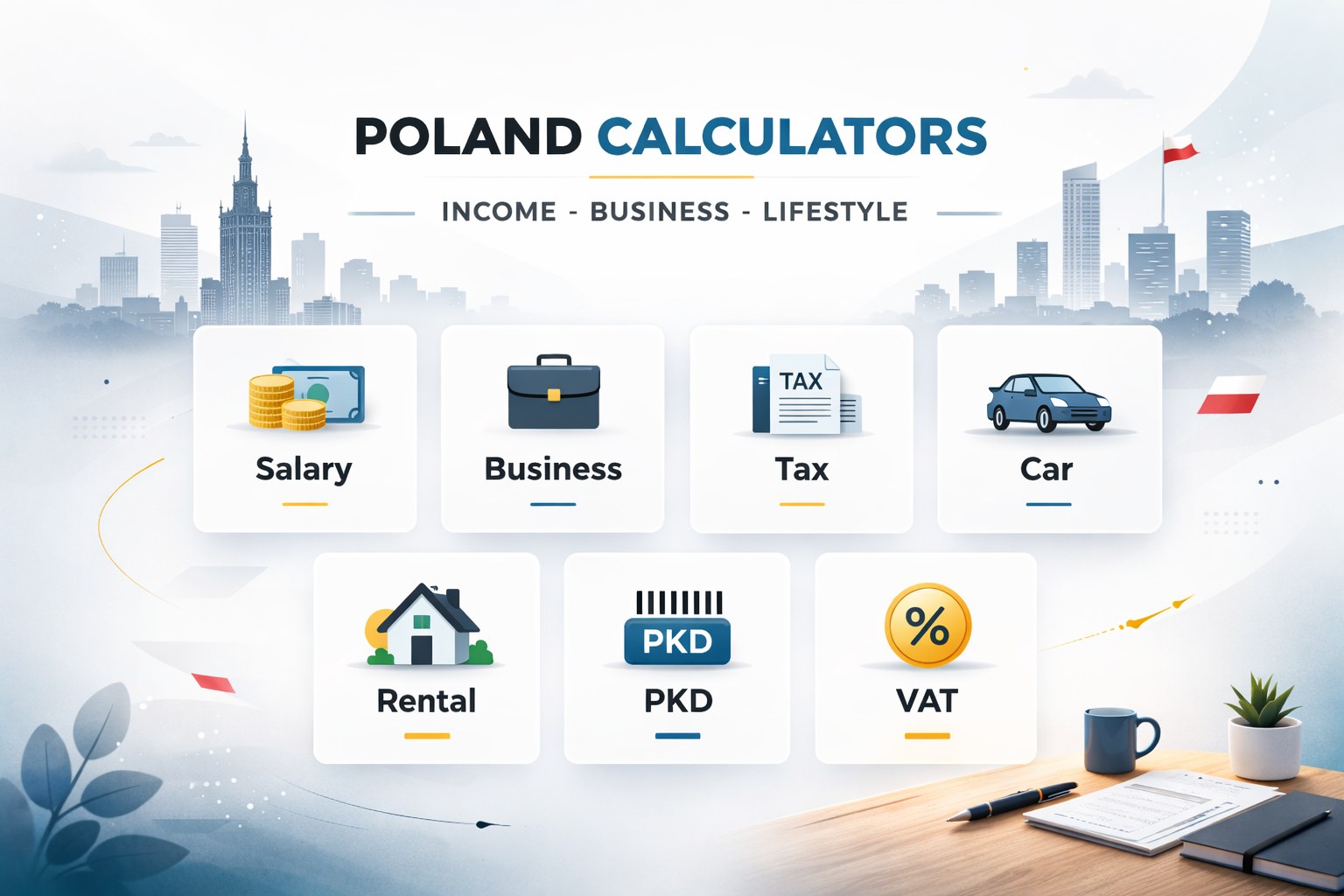
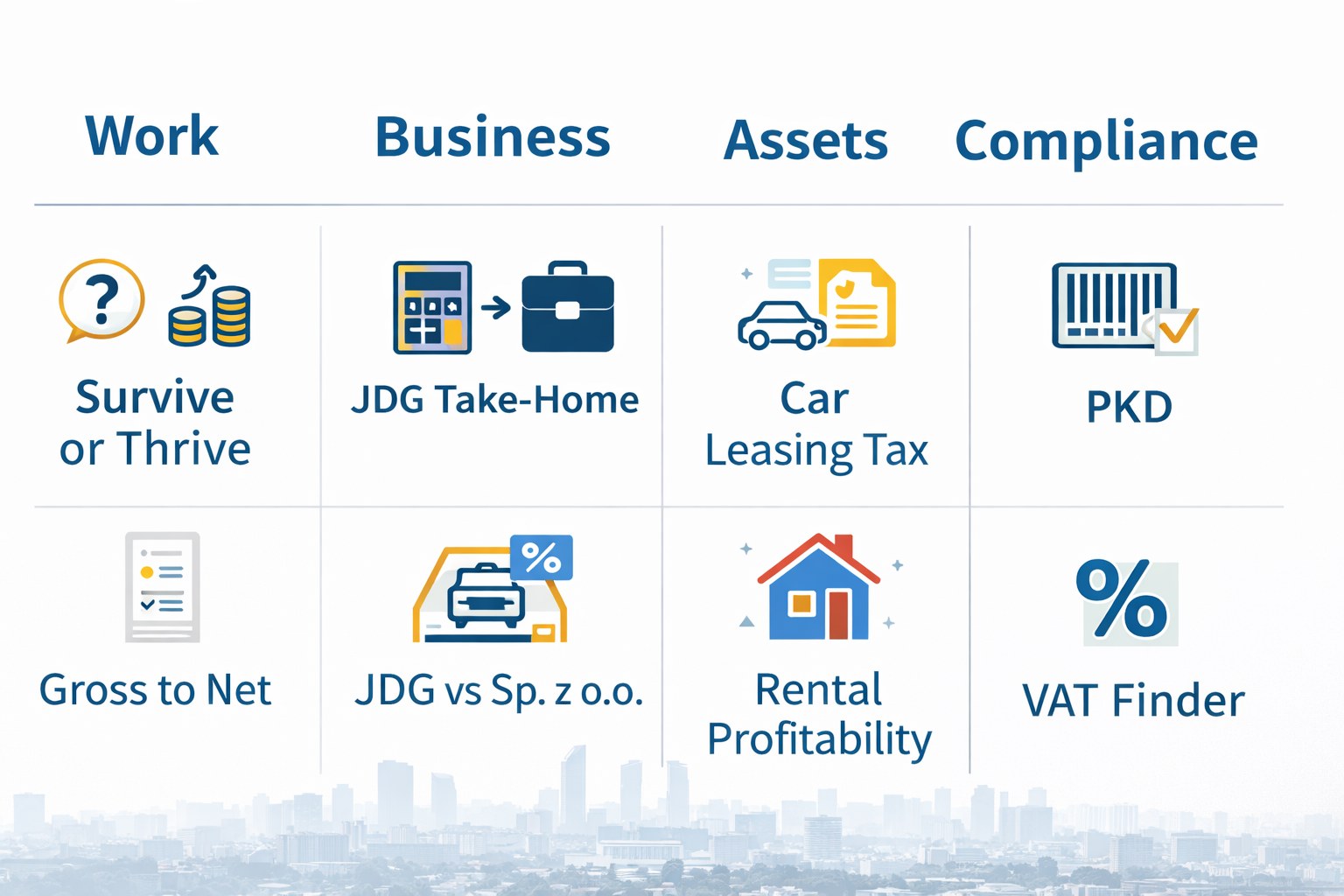
If you’re a foreigner in Poland and you need clarity before you sign a contract, register a business, buy a rental property, or lease a car, the most effective approach is to use a hub page that links to dedicated calculator webpages. This article is that hub. It walks you through 7 Poland calculators for foreigners, explains what each tool is for, what inputs matter, how to read the results, and when you should validate the numbers with a specialist. Use the quick table, pick the calculator that matches your decision, then follow the linked tool page.
Start here: what these calculators solve
Poland calculators for foreigners exist for one reason: the decisions you make in Poland often look simple on paper, then get complicated when the real rules hit. “Gross salary” is not what you keep. “B2B rate” is not what lands in your bank account. “Ryczałt is a flat rate” is true, but the correct rate depends on what you actually do, and VAT is a separate system. Even a “cheap car lease” can become expensive when VAT, deductibility caps, and mixed-use rules are misunderstood.
This hub article is designed to remove the usual friction foreigners hit:
You find a tool, but it’s missing the context (what inputs matter, what the output means, what it ignores).
You find a forum answer, but it’s vague, outdated, or based on someone else’s situation.
You get a number, but you don’t know which “number” you should negotiate: gross, net, invoice, or employer total cost.
English Wizards publishes calculators as full webpages because functional tools need code, structure, and context. That’s also better for SEO and usability: each calculator can target one intent, answer it deeply, and stay maintainable as rules change. This article acts as the single authoritative hub that ties them together and routes you to the correct tool.
Nationwide support, English-first: These calculators are built for English-speaking foreigners across Poland. If you want a human to validate your situation (tax method, ZUS setup, VAT exposure, company structure, or the paperwork that makes the difference), you can use the tools first, then speak with a specialist.
Want your numbers checked by a specialist? Use the calculators first, then book a consultation to validate the choices that create the biggest risk: tax method, structure, VAT, and documentation.
Important reminder before you start: VAT is excluded from several calculators because VAT treatment varies by what you sell, whether you register for VAT, and how your invoices and documentation are structured. If you need the “VAT reality check” layer, start with the PKD and VAT tool and then revisit the other calculators.
Rental Asset Profitability calculator
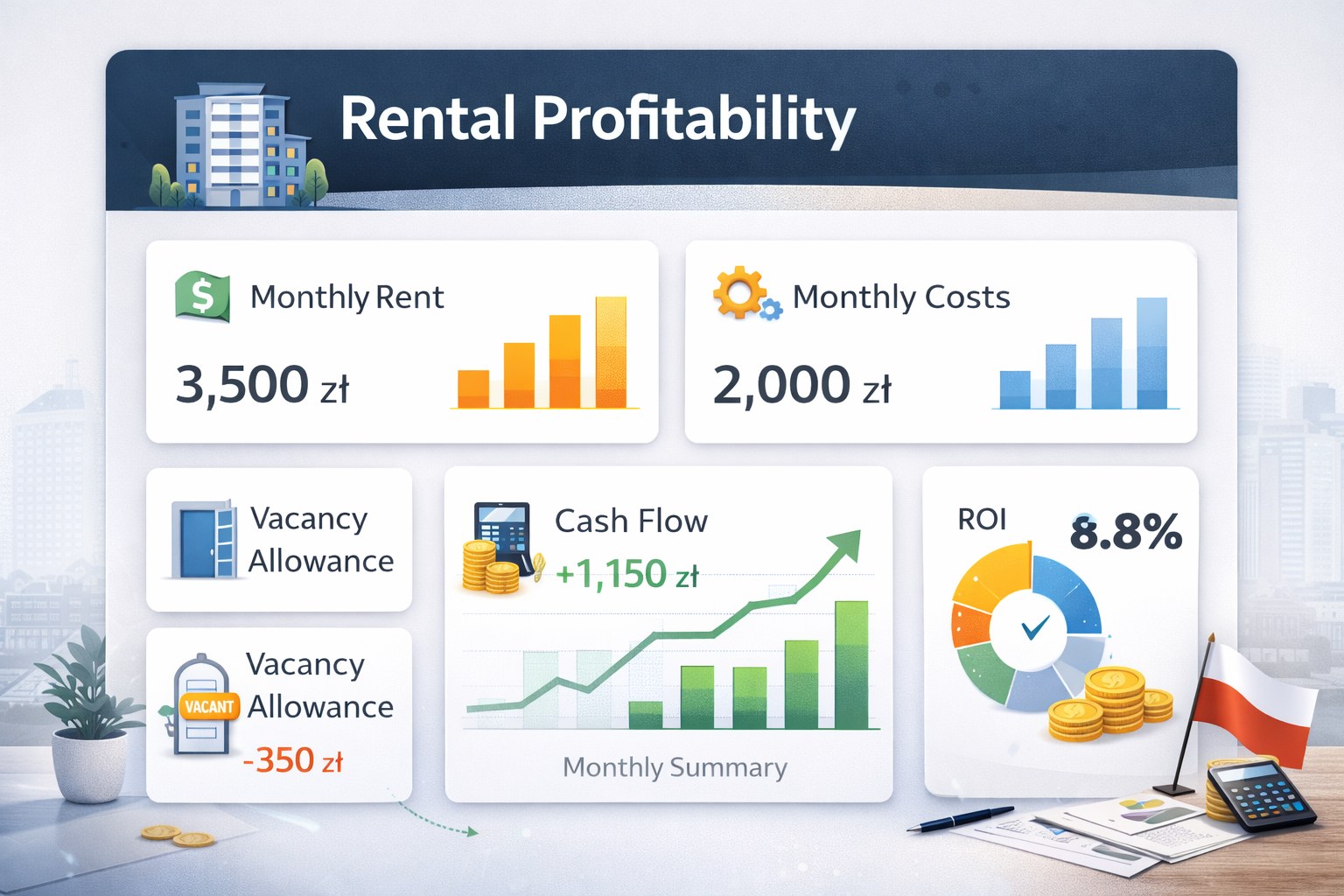
Rental Asset Profitability calculator is built for one decision: “Is this rental deal actually profitable once reality is included?” Foreigners often compare purchase price to rent and stop there. That’s where expensive mistakes start. Real rental profitability depends on recurring costs, vacancy assumptions, maintenance, and how your rental income is taxed.
Use this calculator if you are about to
Buy an apartment in Poland to rent it out.
Switch an existing apartment from personal use to rental income.
Compare long-term rent vs short-term rent scenarios using the same asset.
Decide whether a “good looking” rent number is actually a good investment.
What you should prepare before you start
Expected monthly rent (and the realistic range, not the best-case screenshot).
Monthly building fees (czynsz), utilities, insurance, property management, repairs, and any platform fees.
A conservative vacancy allowance (even if you plan to self-manage).
Your financing assumptions if you’re using a mortgage (or if you’re paying cash, your opportunity cost mindset).
What the calculator gives you
The calculator is designed to move you from “gross rent looks fine” to “net cash flow and ROI are clear.” It helps you stress-test the deal by changing the inputs that normally break profitability: vacancy, fees, and ongoing maintenance. It also frames rental income tax in a way foreigners can actually use.
Private rental income in Poland is commonly taxed via lump sum (ryczałt) rather than profit-based rules, and it has tiered rates depending on revenue levels. Official guidance
How to interpret the result without fooling yourself
Look at worst-case month: a rental is only as stable as your ability to survive the bad months. Add vacancy and maintenance before you celebrate.
Compare “cash flow” vs “ROI”: cash flow matters for lifestyle stability, ROI matters for investment logic. They can tell different stories.
Decide what you’re optimizing: long-term wealth building, monthly income, or flexibility. Each pushes you to different choices.
Ready to run the rental numbers? Use the calculator, then sanity-check your assumptions if the deal is close.
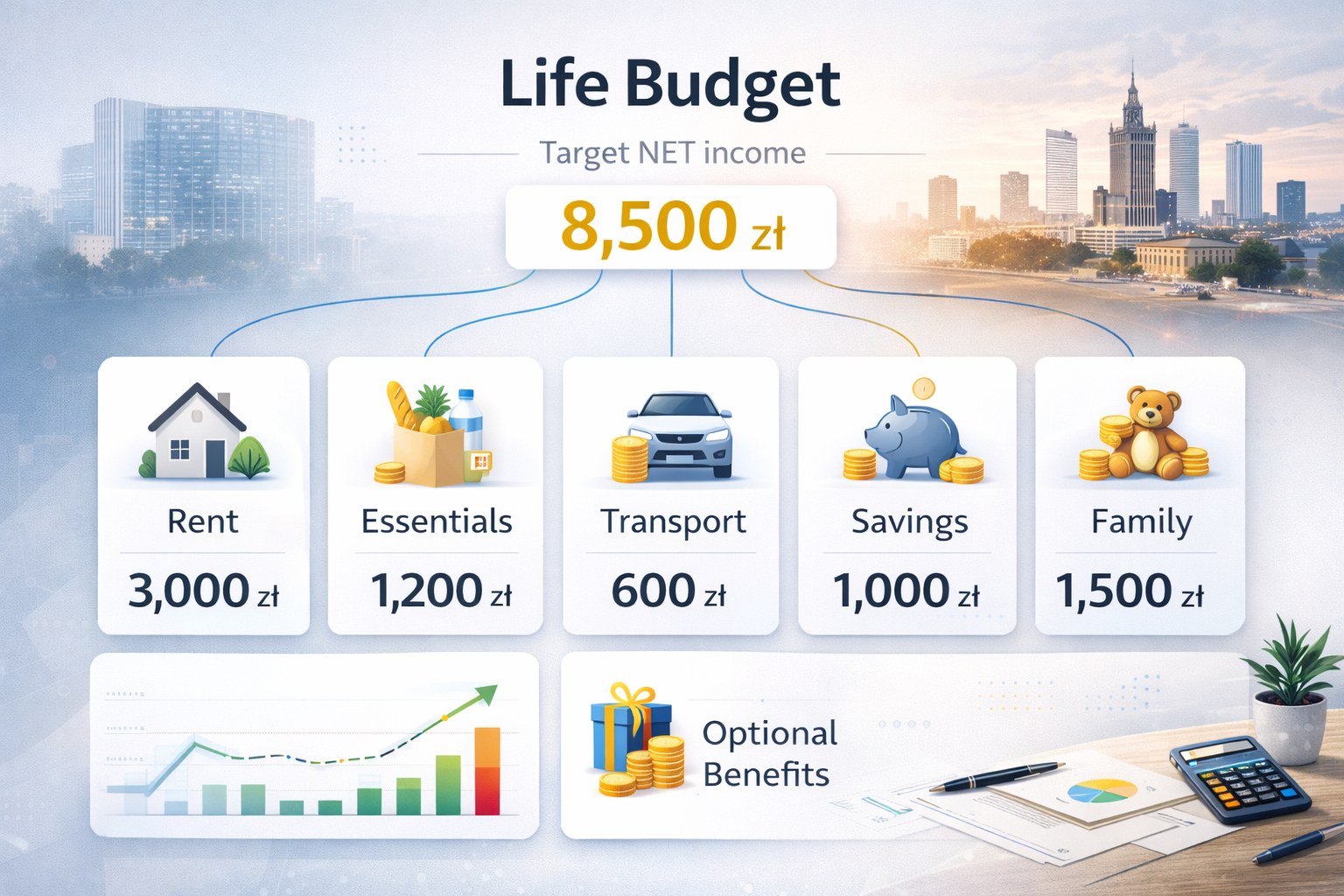
Survive or Thrive is not a “typical salary calculator.” It’s built around a more honest question: what do you need to earn to live the way you want in Poland? Not just “can I survive,” but “can I build a stable life, save, and avoid constant financial stress.”
Foreigners often negotiate from the wrong number because they start from other people’s salaries or from old cost-of-living posts. This calculator forces the right starting point: your lifestyle standard, your living situation, and your goals.
Use this calculator if you are about to
Accept a job offer and you want to check if it supports your life in Poland.
Negotiate salary or benefits and you need a confident target.
Decide between cities, because rent and lifestyle choices change the required income.
Compare UoP (employment) vs JDG (B2B) targets at a high level.
What makes it different
Lifestyle-first inputs: it asks how you want to live, not just what you earn.
Real-world tradeoffs: living alone vs sharing rent, dependants, paid benefits, and savings targets shift the result fast.
Negotiation framing: it gives you a clear target you can defend, instead of “I heard people earn X.”
How to use the output in real negotiations
Use the output as your internal truth. Then translate it into the employer language: you’re not “asking for more,” you’re explaining what the offer needs to be to make sense for you. If the company can’t move on base salary, the output helps you quantify alternatives: paid benefits, relocation support, or the contract structure.
If you want to translate salary targets into take-home under different contract types, pair this tool with the Gross to Net Income calculator so you understand the real difference between gross salary and net money.
Find your realistic salary target. Build your “thrive” target first. Then decide what type of offer makes that target realistic.
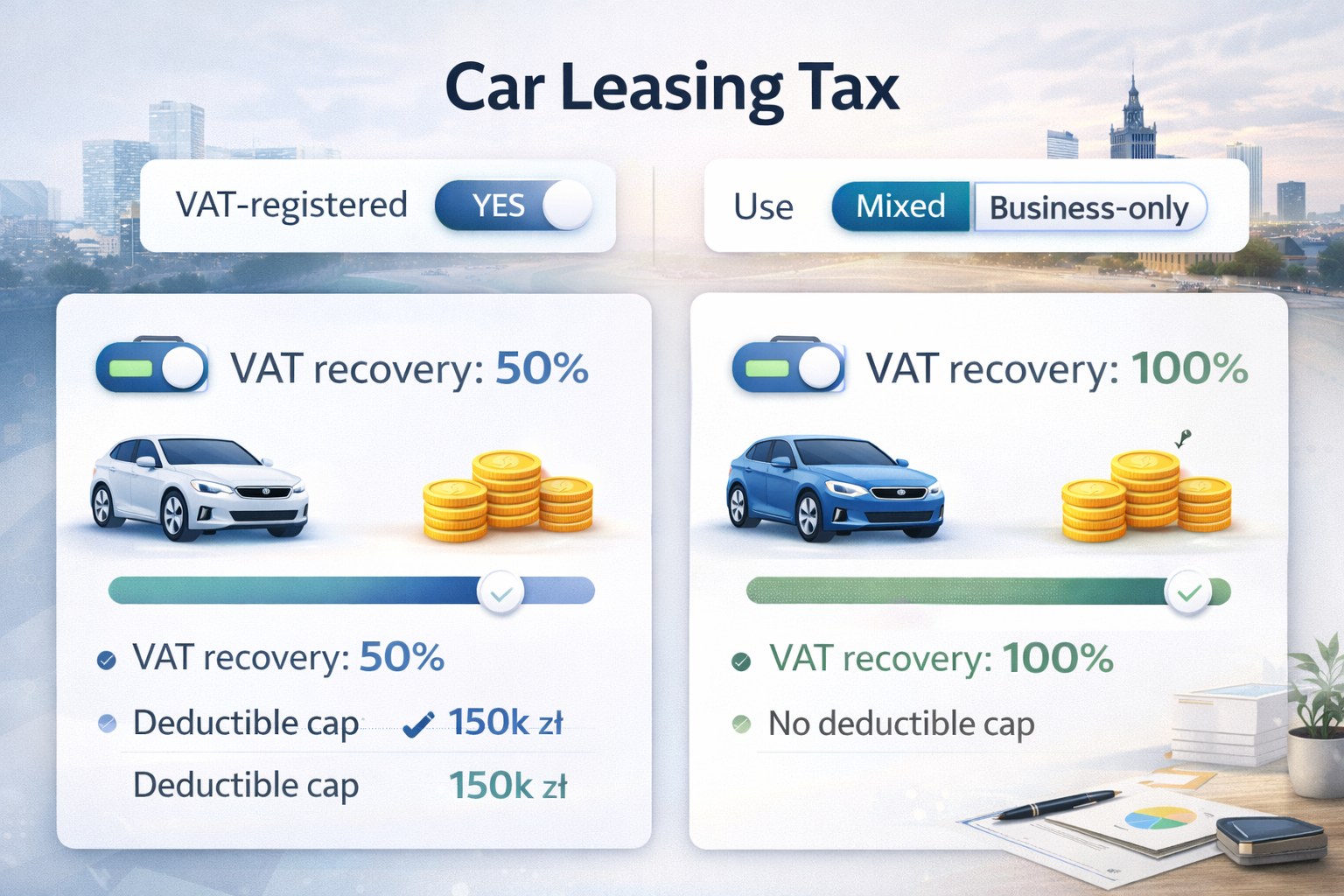
Car Leasing Tax Savings answers a common question foreigners ask too late: “How much does a business car lease really save me after Polish tax rules are applied?”
In Poland, car leasing tax impact usually comes from two layers:
Income tax layer (PIT/CIT): how much of your lease and running costs can reduce taxable income, including caps that depend on the vehicle and emissions.
VAT layer: whether you can recover VAT on car invoices, which often depends on VAT status and business-only vs mixed use.
Officially, the rules and limits are detailed and case-dependent. The “Stawki i limity” materials and official guidance are a useful starting point, and 2026 documentation discusses updated passenger car caps based on emissions and vehicle type. Government investor guide (2026 PDF)
Use this calculator if you are about to
Sign a lease for a car used in your business (JDG or company).
Decide between a cheaper combustion car and a higher-price EV, where caps can change the tax impact.
Decide whether “business-only use” documentation effort is worth it.
Compare leasing vs not leasing from a tax impact perspective.
Inputs that matter most
Your VAT status: if you are not VAT-registered, VAT recovery is typically zero in the simplified model.
How the car is used: mixed use vs business-only can change VAT recovery assumptions and may require formal steps.
Vehicle category and emissions: 2026 caps depend on the vehicle type and CO2 threshold in the tool model. Official reference
Your taxation method: some tax methods benefit less from costs (example: on lump sum ryczałt, costs usually don’t reduce income tax, even though VAT recovery may still matter).
Common mistakes this tool helps you avoid
Assuming a lease “always saves tax” without checking caps and mixed-use limitations.
Assuming 100% VAT recovery without meeting business-only requirements and documentation.
Mixing gross and net amounts (VAT included vs excluded) and getting an unrealistic result.
Estimate your car lease tax impact. Run the numbers before you sign anything, then validate the documentation requirements if you’re aiming for business-only treatment.
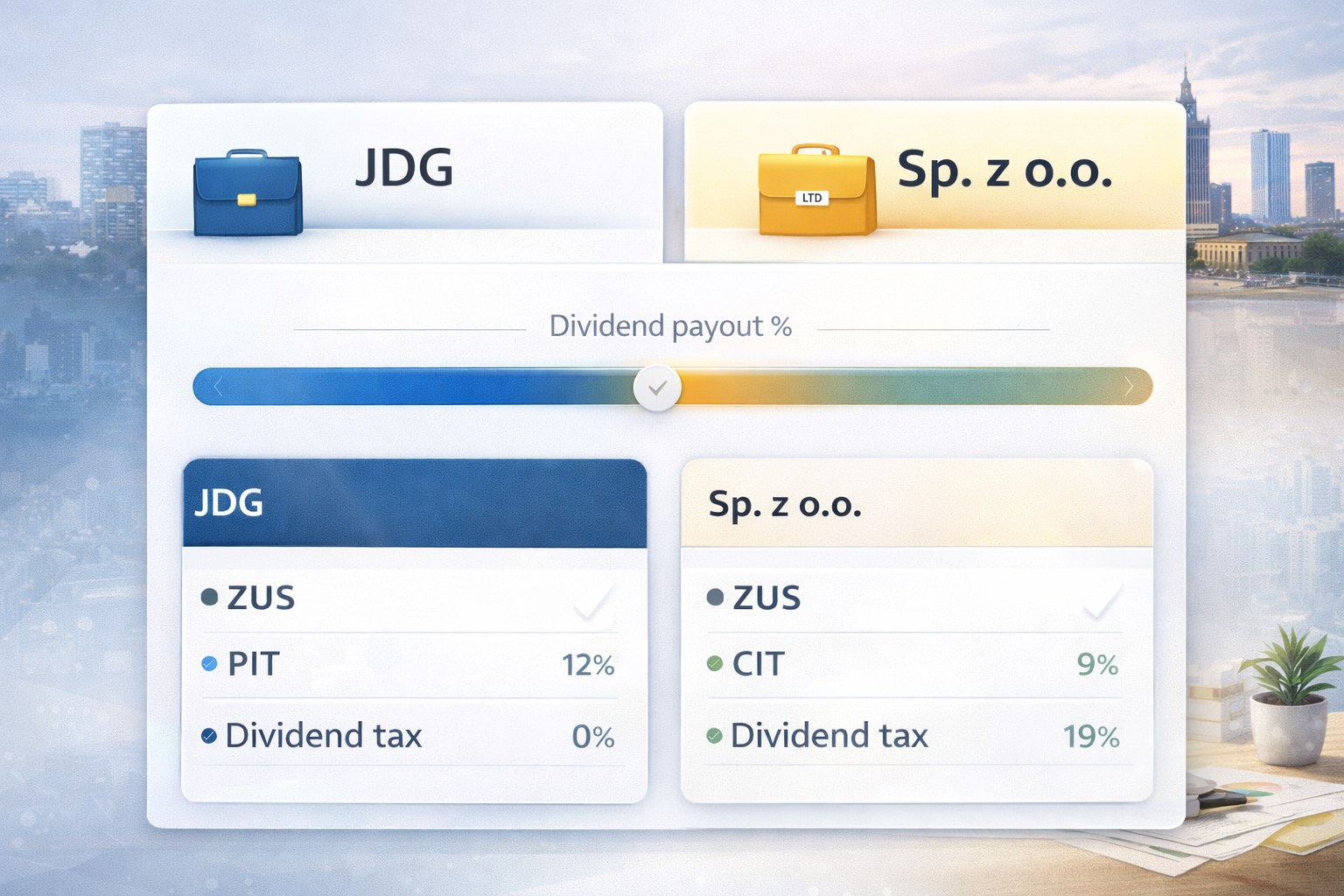
JDG vs Sp. z o.o. Take-Home Calculator exists because foreigners often treat this as a vibe-based decision. “Everyone says Sp. z o.o. is better.” “Accountants say JDG is simpler.” Both can be true, depending on payout strategy, costs, and your ZUS situation.
This calculator gives you a simplified, numbers-first comparison of:
JDG (sole trader): PIT plus ZUS contributions on the JDG side.
Sp. z o.o. (limited company): modelled as classic CIT + dividend payout (simplified), with dividend tax applied on distributed profit.
Corporate income tax rates depend on eligibility and conditions, and official guidance summarises the classic CIT rates. Official CIT rates and limits
Use this calculator if you are about to
Register a business and you’re deciding between a sole trader setup and a company.
Switch from JDG to a company because your revenue is rising or your risk profile is changing.
Understand how dividend payout decisions affect “take-home now” vs “keep profit in the company.”
What most people get wrong about this comparison
They compare structure names, not payout strategies: a company can pay out money in different ways. A dividend-only model is not the only way, and it changes the result.
They ignore admin reality: bookkeeping and compliance can be very different between JDG and a company. Even if take-home is similar, workload may not be.
They forget VAT: VAT isn’t included in the simplified model, but VAT can dominate cashflow and admin.
How to make the output useful
Use it to understand the “money mechanics” first. Then ask the second question: “What structure will I realistically run well?” If your results are close, the best decision is rarely made by a calculator alone. It’s made by checking risk, compliance tolerance, and the documentation you’re prepared to maintain.
If you are on (or considering) ryczałt and you’re not sure about your rate, use the PKD and VAT tool first: Find your PKD code and VAT rate.
Compare JDG vs Sp. z o.o. take-home. Run a simplified comparison, then validate your best structure based on payout strategy and compliance reality.
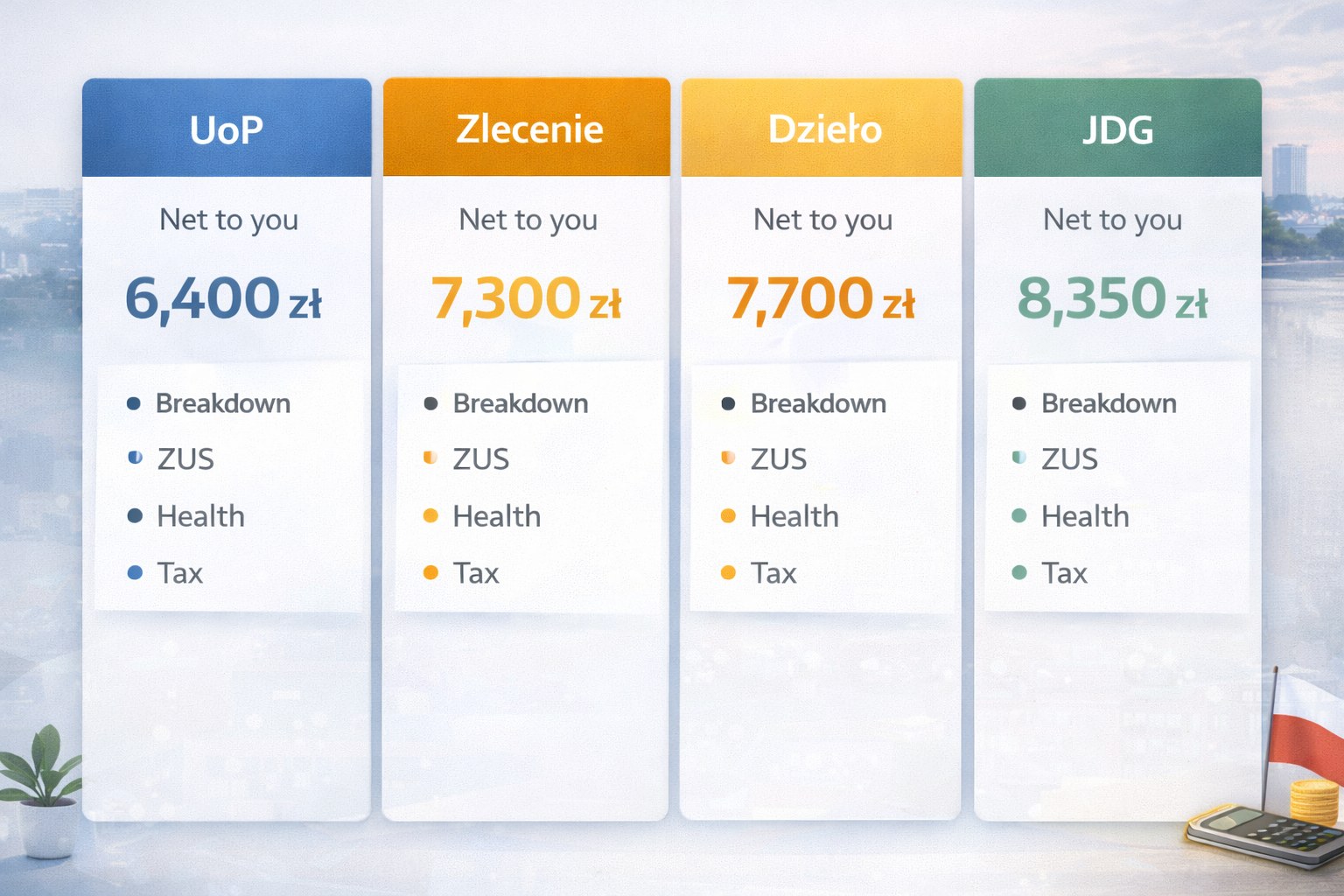
Gross to Net Calculator is the “reality translator” for foreigners comparing contract types in Poland. It lets you enter a gross amount and see an estimated monthly take-home under:
UoP (Umowa o Pracę, employment contract)
Zlecenie (Umowa zlecenie, mandate contract)
Dzieło (Umowa o dzieło, specific work contract)
JDG (B2B), modelled as a simplified ryczałt path in the tool
The value of this calculator is not the single “net” number. It’s the side-by-side breakdown. That breakdown teaches you what costs exist and why foreigners often misread offers.
Use this calculator if you are about to
Compare a Polish job offer across different contract types.
Negotiate an offer and you want to translate “gross” into “what I keep.”
Understand employer cost and the difference between “company budget” vs your net.
What inputs matter most
Contract type: UoP, zlecenie, and dzieło are not interchangeable. They change ZUS and tax treatment.
Whether your work includes copyright/IP deliverables: in the calculator logic, this affects the estimate for KUP (costs of earning income) under specific contracts.
If you’re comparing to B2B: your ryczałt rate and your costs assumptions matter, even in a simplified model.
Then use Gross to Net to translate offers into comparable take-home numbers.
If B2B is on the table, use the dedicated JDG Take-Home calculator for deeper tax-method comparison.
Translate gross salary into take-home. Use this when you need clarity fast, then go deeper with the JDG Take-Home calculator if you’re considering B2B.
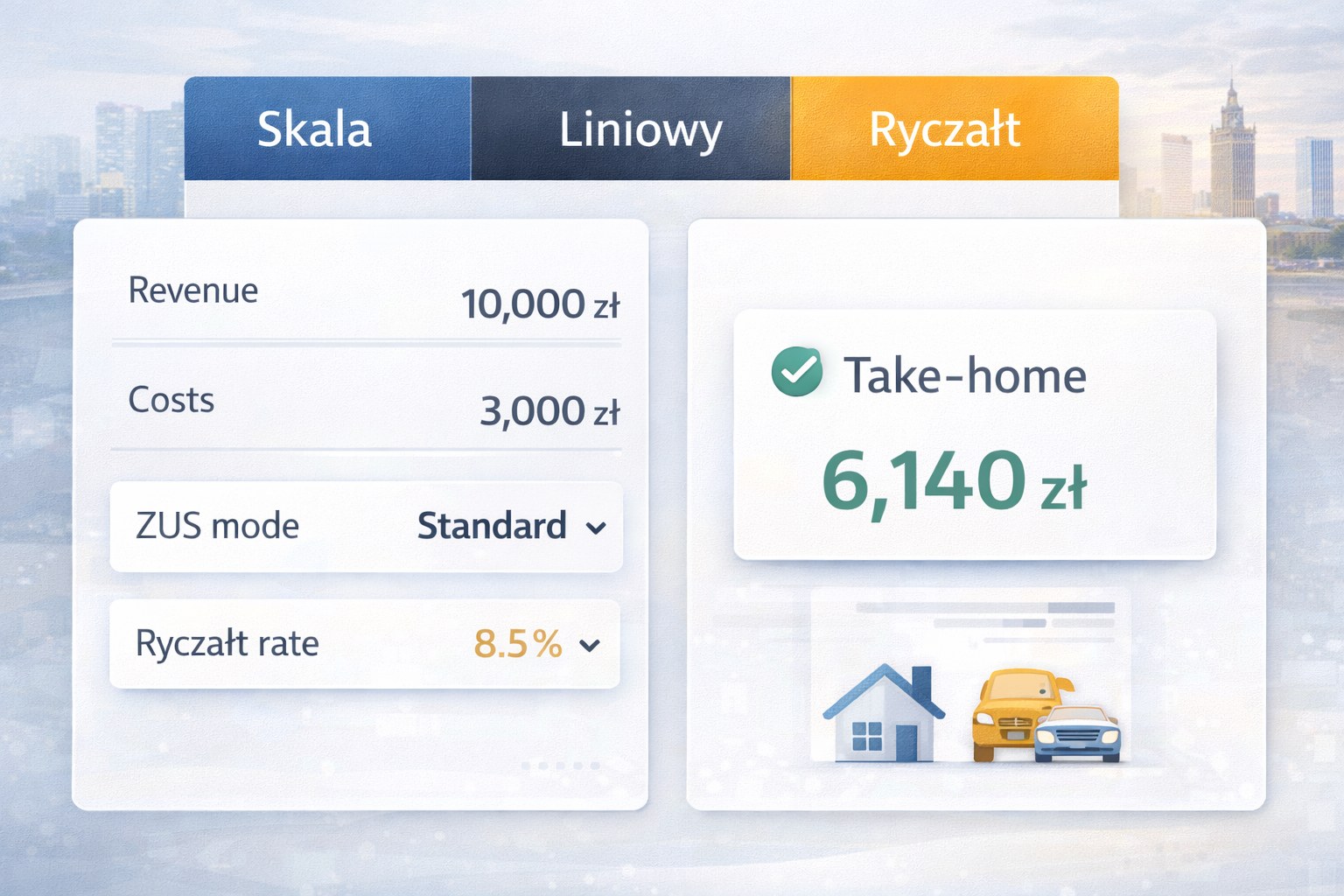
Poland B2B Tax Calculator is the dedicated tool for foreigners earning on B2B (JDG, sole trader). It compares estimated take-home across the three most common options:
Skala (tax scale)
Podatek liniowy (flat tax)
Ryczałt (lump sum tax on revenue)
The tool is explicit about the core reality: skala and liniowy depend on profit (revenue minus deductible costs), while ryczałt depends on revenue and the rate you choose. That’s why two people on the same invoice amount can end up with completely different take-home.
Use this calculator if you are about to
Register a JDG and choose a tax method.
Switch tax methods and want to see what changes your take-home the most.
Decide whether “higher deductible costs” actually make profit-based methods better.
Stop guessing your ryczałt rate and get serious about classification and compliance.
The two inputs that usually change the result the most
Deductible costs: higher costs can improve skala or liniowy relative to ryczałt, because those methods tax profit, not revenue.
Your correct ryczałt rate: choosing the wrong rate can make the “best” result meaningless. Your rate depends on what you do and how it is classified, often tied to PKWiU logic, not just PKD labels.
VAT note you should not ignore
Several of the calculators (including this one) treat inputs as net of VAT and exclude VAT modelling. That’s deliberate because VAT obligations depend on what you sell and whether you register. The VAT exemption limit is 240,000 PLN from 1 January 2026 (with exceptions). Official VAT limits
If VAT might apply to you, use the PKD and VAT tool before you decide you’re “safe because ryczałt.” VAT and ryczałt are different systems.
Compare B2B take-home properly. Use this calculator when you need a clean skala vs liniowy vs ryczałt comparison based on your real costs.
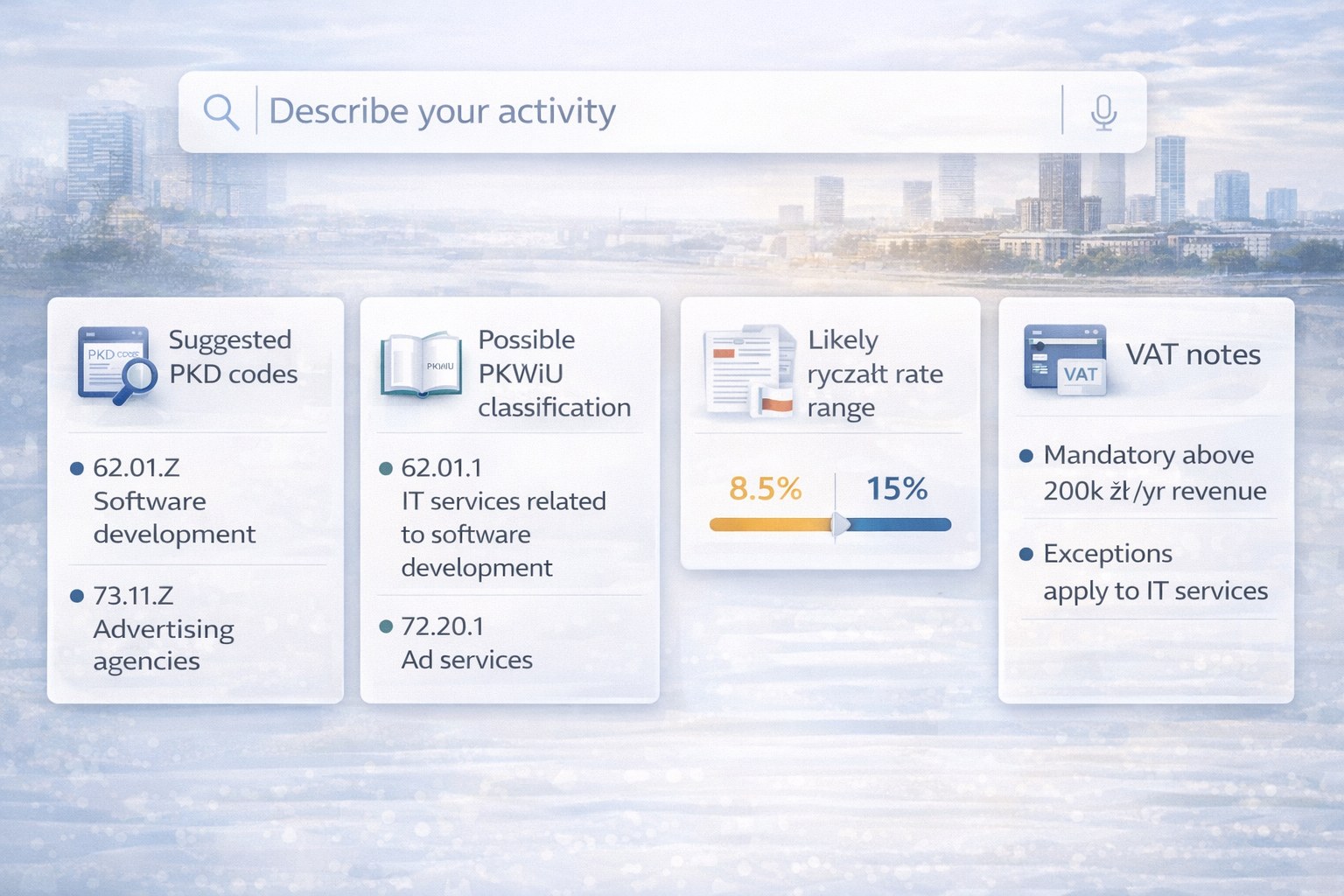
Find the Right PKD Code for Your Business in Poland is the tool you should use before you register anything, especially if you are considering ryczałt. It is built around a hard truth that foreigners discover late: your ryczałt rate is not chosen by PKD alone. It depends on the legal category of your activity, often linked to classification logic (commonly PKWiU). VAT is separate from ryczałt, so VAT obligations do not disappear just because you choose ryczałt.
Use this tool if you are about to
Register a JDG and you’re unsure which PKD codes fit what you actually do.
Choose ryczałt but you’re not confident about your rate.
Sell services or products where VAT rate and VAT exposure are not obvious.
Run mixed activities and you need to understand how multiple rates can apply.
Why this matters more in 2026
VAT exemption limit: the VAT exemption limit is 240,000 PLN from 1 January 2026 under standard rules (with exceptions). Official VAT limits
PKD update context: Poland uses PKD 2025, with a transition period allowing older PKD codes in some cases until 31 December 2026. GUS PKD 2025 info and GUS PKD 2025 FAQ
Formal VAT rate certainty: if you need formal confirmation of VAT classification and rate, Poland uses WIS (Wiążąca Informacja Stawkowa). Official WIS guidance
How to use this tool without creating false confidence
Describe what you actually do: not your job title, not your LinkedIn headline. Describe the deliverables.
Treat the output as direction, not a legal ruling: classification can be simple for some work and genuinely ambiguous for mixed services.
Use it to ask better questions: it helps you prepare the right questions for your accountant or specialist, including whether you should request a formal classification or WIS.
Don’t guess your PKD or ryczałt rate. Use the tool to map what you do to PKD and VAT realities, then validate if your case is ambiguous.
When people get bad outcomes in Poland, it’s rarely because they didn’t have access to “a calculator.” It’s because they used the wrong calculator first, or because they treated a number as final without checking the inputs that control risk.
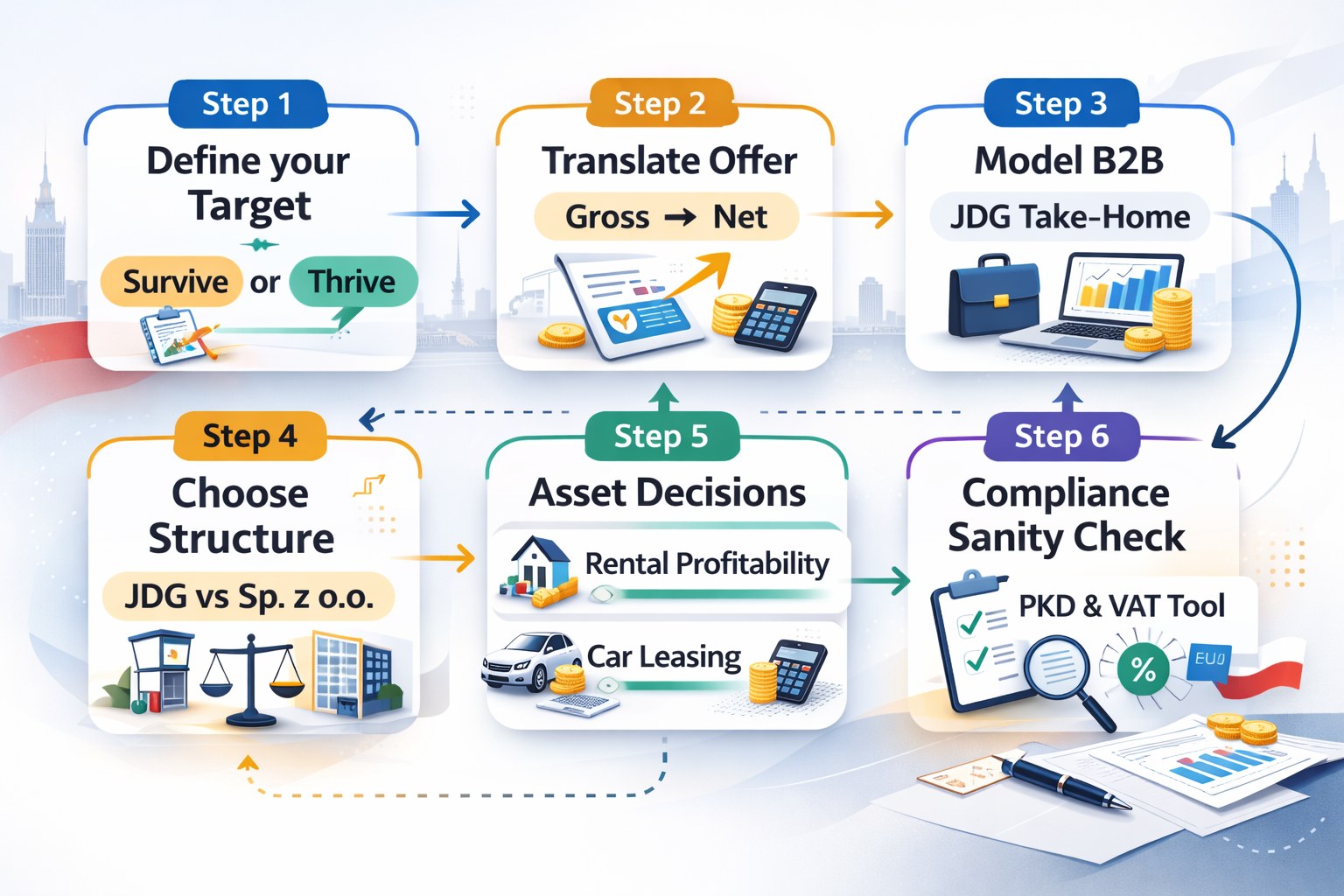
Here’s the workflow that produces the cleanest decisions for most foreigners:
1) Define your life target, not your ego target
Start with Survive or Thrive. This gives you a target net income based on your lifestyle, not on someone else’s opinion of what “good pay” is.
2) Translate offers into comparable take-home numbers
Use Gross to Net to compare UoP, zlecenie, dzieło, and a simplified JDG estimate. This step stops you from comparing apples to oranges.
3) If B2B is real, model B2B properly
If you are actually considering B2B or already invoicing, use the dedicated JDG Take-Home calculator. It’s built around the inputs that matter for B2B: deductible costs, tax method choice, ZUS situation, and ryczałt rate assumptions.
4) If structure is the decision, model the structure tradeoffs
If you are deciding between a sole trader setup and a company, use JDG vs Sp. z o.o. and pay attention to payout strategy and the admin reality. The calculator gives you a simplified number, then you decide if you can run the structure well.
5) If assets are involved, model the asset decision separately
Rental property and car leasing are separate decisions with separate risk layers. Use:
Before you lock in ryczałt assumptions or VAT assumptions, use Find your PKD code and VAT rate. If your case is genuinely ambiguous, treat the tool as a direction generator, then validate with a specialist or formal ruling paths like WIS. Official WIS guidance
If you want the fastest path: run the calculators first, then book one consultation to confirm your tax method, VAT exposure, and documentation requirements.
Scenario 1: You got an offer, but you don’t know if it supports your life
You receive a job offer in Poland and the first instinct is to compare it with what you earned at home or what you see in expat groups. That usually leads to a wrong conclusion because it ignores how life in Poland will look for you, not for “the average person.”
Start with Survive or Thrive. Set your living situation (living alone or splitting rent), add dependants if applicable, and be honest about your savings goals. This step produces one key output: the net income you need for your lifestyle standard. It gives you a negotiating anchor that is internally consistent.
Next, take the offer amount and run it through Gross to Net so you can see what you keep after the typical components on that contract type. If your offer is UoP, you now understand the take-home and you can compare it to your Survive or Thrive target. If it’s zlecenie or dzieło, you get a comparable estimate without guessing.
If the company hints at a B2B arrangement, treat it like a separate decision. Use JDG Take-Home to model skala vs liniowy vs ryczałt based on your real expected costs. This is where foreigners often make the biggest mistake: they hear “ryczałt is only X%,” then forget that ZUS and health contributions exist, and forget that the correct ryczałt rate depends on classification. A clean estimate needs the right rate logic or at least a conservative assumption.
Now you can negotiate using the correct comparison: not gross salary vs invoice, but net to you and total cost to the employer. This is also where the “break-even invoice” insight becomes practical. If the employer has a fixed budget, you can ask for a different structure only if the net works for you. If it doesn’t, you either adjust expectations, adjust lifestyle, or reject the offer. That is the outcome you want from calculators: clarity early, not regret later.
Scenario 2: You’re building a business and you want to avoid structural mistakes
You plan to work independently in Poland and you want to choose the right setup from day one. Many foreigners start by copying a structure someone else used, then later discover that their activity, costs, and documentation needs were different.
Start with the compliance layer: Find your PKD code and VAT rate. Describe what you actually do. The goal is to avoid picking a tax method based on a guessed classification. It also helps you understand VAT exposure. Even if you choose ryczałt, VAT obligations can still exist, and in 2026 the VAT exemption limit is 240,000 PLN under standard rules (with exceptions). Official VAT limits
Next, model your take-home with JDG Take-Home. Use realistic cost assumptions, not optimistic ones. This is how you learn if skala or liniowy becomes competitive versus ryczałt as your costs change. It also forces you to confront the part that hurts: ZUS and health contributions are not optional in most real cases.
If you are debating whether you should run this as a company, use JDG vs Sp. z o.o.. Use it for what it is: a simplified model that shows how PIT/ZUS compares with CIT and dividend logic. Then apply common sense: if the results are close, the deciding factor may be admin, risk tolerance, and whether you want to keep profit inside the company for reinvestment.
If your business will include a car lease, run Car Leasing Tax Savings before you sign. Leasing decisions are full of hidden traps: caps, mixed-use limitations, and documentation expectations for business-only use. If you plan to buy a rental property on the side, model it as its own decision with Rental Asset Profitability. Don’t mix business confidence with investment confidence. They are different risk profiles.
This is what “being practical” looks like: you map classification and VAT exposure first, model take-home second, decide structure third, and only then take on assets like cars or property with a clear view of cost and compliance.
FAQ
Are these Poland calculators for foreigners accurate enough to make decisions?
They’re accurate enough to stop guesswork and force clarity, which is the point. A good calculator does two things at once: (1) it gives you a reasonable estimate based on known rules, and (2) it shows which inputs matter so you can test your own assumptions. That second part is what protects you from costly mistakes.
What they are not: they are not a replacement for professional accounting, legal advice, or a case-specific tax ruling. Two people can enter the same revenue and still have different outcomes because the real-world differences aren’t always numeric. Examples include: VAT status, the exact classification of a service (especially when your work is mixed or bundled), residency and treaty positions, documentation quality, or whether a cost is actually deductible in practice. Some of those are judgement calls, and some require official confirmation.
That’s why this hub exists. Each calculator page is designed as a full webpage so it can include the assumptions, exclusions, and the “how to interpret” section, not just the tool. If you run a calculator and your result is close to a decision boundary, treat that as a signal to validate. If the result is not close, the calculator has still done its job by making the decision obvious.
The best way to use these tools is to run at least three variations: conservative, realistic, and optimistic. If your decision only works in the optimistic version, it’s not a stable decision. If it works in the conservative version, you have a strong position. Then, if you need help turning the result into the right structure, you book a consultation. That’s the workflow that makes calculators valuable without pretending they replace humans.
Do you support foreigners across all of Poland or only Warsaw?
English Wizards supports foreigners across Poland. The calculators are available anywhere, and consultations can be used regardless of where you live. This matters because a lot of expat guidance online is city-biased. Warsaw content dominates the internet, then people move to Kraków, Wrocław, Gdańsk, Poznań, Łódź, Katowice, or smaller cities and discover the real differences are in rent, lifestyle costs, and local admin friction.
From a calculator point of view, the “nationwide” part is simple: taxes and legal structures are national rules, but the numbers you feed the calculators can be city-specific. Your rent assumptions, commuting costs, and lifestyle standard should reflect your real location. That’s exactly why Survive or Thrive exists. It forces you to build a target based on your life, not on a generic online number.
From a support point of view, what changes by city is usually the practical process: timelines, local office practices, and which services you need at which stage. That’s why the best sequence is: use the calculators to define the numbers, then use support services to execute the plan.
If you’re unsure whether your plan is viable outside a major city, the tools still help. You can model a conservative scenario with higher costs or higher admin overhead and see if the plan is resilient. If you want someone to sanity-check the plan and execution steps, use the consultation option.
How does pricing work for consultations and is it different by city?
Pricing is not something a calculator should guess. It depends on what you need, the complexity of your case, and the scope of support. The practical way to think about it is: you’re paying for risk reduction and clarity. For many foreigners, one wrong move costs more than the consultation because it creates admin debt, tax risk, or months of cleanup work.
City doesn’t usually change the core logic of the work. Taxes and most structural decisions are national. What can change is the process friction and the time needed for execution, especially when local offices or local requirements create extra steps. That’s why the cleanest approach is to use the calculators first: you show up with your numbers, your assumptions, and the decision you’re trying to make. That makes any professional support more efficient.
If your case is simple, a consultation can be a fast validation of your tax method choice, your contract structure, or whether you’re missing a VAT exposure. If your case is complex, you use a consultation to map the plan and the next steps, then decide what support you need to execute.
If you want a practical shortcut: run the calculators for your real numbers, write down the three biggest uncertainties you still have, and bring those to a consultation. That turns the session into a decision-making session instead of a general chat.
What’s the biggest mistake foreigners make with ryczałt and PKD?
The biggest mistake is thinking PKD automatically tells you your ryczałt rate and VAT situation. PKD is primarily a registration classification. Ryczałt rates depend on the legal category of the activity, often linked to classification logic that may refer to PKWiU in practice. VAT is a separate system that depends on what you sell and what rules apply to that supply. That’s why foreigners can register “correctly” and still be wrong about tax reality.
There is also a second layer: mixed activities. Many foreigners do more than one kind of work, or they sell a bundle that contains multiple elements. In those cases, more than one rate can apply and record-keeping needs to support separating revenue streams. If you cannot separate, you can end up paying the higher rate on everything, or you end up in a compliance dispute. This is not theoretical, it’s exactly how “ryczałt is easy” becomes “ryczałt is messy.”
That’s why the correct approach is to treat classification as a decision-making step, not an admin step. Use Find your PKD code and VAT rate early. If the tool output shows ambiguity, don’t force certainty. Use it to ask better questions, and if needed, look at formal paths like WIS for VAT rate certainty. Official WIS guidance
The payoff is huge: one correct classification decision early prevents years of risk and cleanup later.
Conclusion and next steps
If you take one thing from this hub, make it this: the best decisions in Poland are the ones you model before you commit. These Poland calculators for foreigners are built to help you do that in plain English, without relying on guesswork or vague forum answers.
Pick the calculator that matches your decision, run conservative and realistic versions, and treat “close results” as a sign to validate with a specialist. If you spot a gap, a confusing assumption, or a tool you wish existed, feedback helps us improve the calculators and keep them aligned to reality.
Want help turning calculator results into a clean plan? Use the calculators, then get a specialist to validate the high-risk parts: structure, VAT exposure, and documentation.
Government investor guide referencing 2026 tax context and selected limits (PDF): podatki.gov.pl
About the author and review
Author: English Wizards Team (English-first support for foreigners in Poland)
• Review date: February 2026
Update policy: This hub and the linked calculators are maintained to reflect rule changes. If you notice an outdated assumption, use the calculator page feedback path or book a consultation to validate your case.
Tax clearance certificate Poland – learn the legal basis, ZAP-3 registration, how to find your tax office, and 4 ways to get a personal no-arrears certificate.
by English Wizards |
December 5, 2025 |
Living in Poland
Youth leadership mission trips Poland equip teens with discipleship, bilingual ministry, and leadership skills while serving alongside Polish youth.
by English Wizards |
August 23, 2025 |
Faith & Missions
Your privacy choices
We use cookies (not the tasty ones) to keep English Wizards running smoothly and to understand how people move through the site. You choose what extra magic we can use.
Essential
Always active
These cookies are required for the website to work correctly and cannot be disabled.
Preferences
These cookies remember your settings so the site feels consistent every time you visit. They don’t track you — they only store things like language, region, or layout choices.
Analytics
These cookies help us understand how visitors use the site so we can improve it. No personal data is used unless you allow it.The technical storage or access that is used exclusively for anonymous statistical purposes. Without a subpoena, voluntary compliance on the part of your Internet Service Provider, or additional records from a third party, information stored or retrieved for this purpose alone cannot usually be used to identify you.
Personalization
These cookies allow us to use Google Signals and similar tools to personalize content and understand our audience better.